
- Access Control System
How Access Control Systems Work With Existing Locks
- Locksmith Urbana IL
- 8 min read
- Urbana, IL. 61801 / 61802
The most common question we hear from Champaign County business owners considering access control isn’t about credentials or cost, it’s simpler than that: does this mean tearing out our doors? In the overwhelming majority of cases, no. Access control with existing locks is not only possible, it’s the standard approach most retrofit installations take, and understanding exactly how that compatibility works helps you avoid both unnecessary expense and unrealistic expectations.
This guide focuses specifically on what happens at the mechanical level when access control gets added to a door that already has a lock, not the credential types or broader access control concepts covered elsewhere on this site.
Two Genuinely Different Retrofit Paths: Wired and Wireless
Nearly every competitor article treats retrofit as a single, vague reassurance, “yes, it’s compatible.” What actually matters is which of two fundamentally different retrofit approaches fits your specific door and budget.
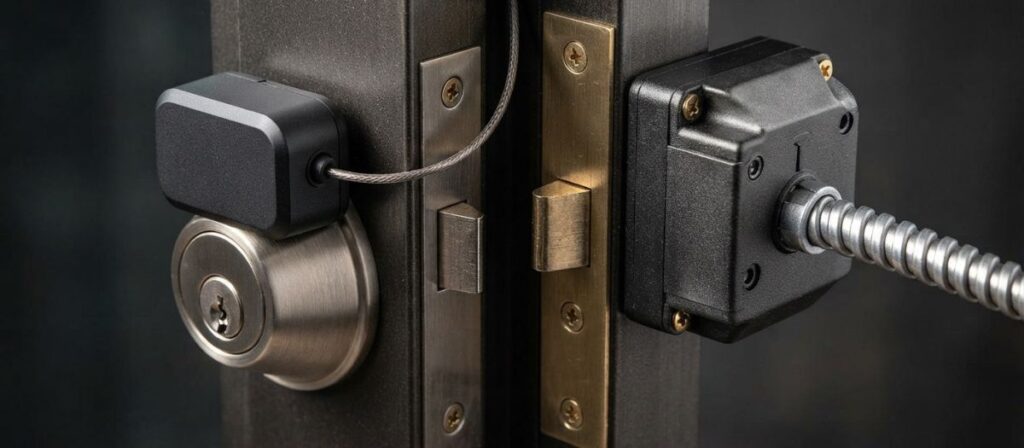
Wired retrofit replaces your existing mechanical lock’s function with an electrified equivalent, an electric strike installed in place of the standard strike plate, or an electrified lock body that fits the same door prep as your current hardware. This requires running low-voltage wiring from the door to a controller and power supply, which means either fishing wire through walls and door frames or running conduit where wiring isn’t already in place. Electric Strike vs Magnetic Lock blog covers what that underlying hardware actually does once installed.
Wireless retrofit takes a different approach entirely. Battery-powered smart locks install much like a standard lock, no wiring runs to the frame or through walls required, and communicate with the access control system through a wireless gateway or hub rather than a hardwired connection. This eliminates the labor cost of running wiring, which is often the single biggest expense in an older building retrofit, but introduces its own ongoing requirement: batteries need periodic replacement, and the wireless connection needs occasional syncing to stay current with permission changes.
Neither approach is universally better. The right choice depends on your door’s existing wiring situation, your building’s construction, and whether you’re prioritizing lower upfront labor cost or lower long-term maintenance.
What Actually Happens to Your Existing Lock Body
Here’s the mechanical detail almost no competitor explains clearly, and it matters directly for older commercial buildings around Downtown Urbana.
Retrofit access control generally doesn’t require replacing your entire door or frame. In most cases, only the lock body or cylinder itself gets replaced with an electrified equivalent designed to fit the same door prep, the specific cutout and hardware pattern already machined into your door. A cylindrical lock prep accepts a cylindrical electrified replacement; a mortise lock prep needs a mortise-compatible electrified unit. The door and frame themselves typically stay untouched.
This is why door prep compatibility matters more than most business owners realize when getting a retrofit quote. A locksmith needs to identify your existing lock’s prep type before recommending hardware, since forcing a mismatched replacement into the wrong prep either doesn’t work correctly or requires costly frame modification that a properly matched replacement would have avoided entirely. For a historic Downtown Urbana storefront with original door hardware from decades past, this compatibility check is the difference between a straightforward retrofit and a much more invasive, expensive project.
The Narrow-Stile Storefront Problem
This is a genuinely underexplained constraint that matters specifically for Champaign County’s retail and Campustown commercial corridors.
Glass storefront doors with narrow aluminum frames, common throughout local retail strips, have limited internal space to accommodate hardware. A standard electric strike or exit device sized for a typical hollow-metal commercial door often doesn’t physically fit inside a narrow-stile aluminum frame without modification. This isn’t a compatibility issue in the access control sense, it’s a physical space constraint that requires narrow-stile-rated hardware specifically designed for these slimmer door profiles.
If your business operates out of a glass storefront, this is worth raising directly when getting a retrofit quote, since not every access control installer defaults to narrow-stile-compatible hardware, and discovering the mismatch mid-installation costs more time and money than confirming compatibility upfront.

Retrofitting Panic Hardware and Exit Devices
If your building has doors already equipped with panic bars or exit devices, adding access control to those doors involves a specific retrofit path rather than a standard lock swap.
An existing mechanical exit device can often be retrofitted with an electrified version of the same device, or paired with electric latch retraction, which allows external credential-based entry while the interior push-bar release continues to function exactly as required for free egress. Panic Bars and Push Bars blog covers the Illinois fire code requirements governing when these devices are legally required and how they must operate; the retrofit consideration here is that adding access control to a panic-hardware door cannot compromise that door’s free-egress function, regardless of the credential system layered on top.
If delayed egress locking is part of your security plan, that setup requires integration with your building’s fire alarm system, and a certified technician needs to verify the installation meets code before it’s considered complete. This is not a project to treat as a simple hardware swap, since getting it wrong creates a life-safety compliance problem, not just an inconvenience.
What Most Retrofit Guides Don't Tell You
A handful of practical realities get skipped or oversimplified across the competitor content we reviewed.
Your lock’s ANSI grade doesn’t disappear when it goes electric. Electrifying a lock body adds credential-based control, but the underlying mechanical durability, how many open-close cycles it survives, how much force it resists, still depends on its ANSI/BHMA grade. Lock Security Grades for Commercial Doors blog covers what those grade differences mean. A high-traffic main entrance still needs Grade 1 durability whether it’s mechanical or electrified, and an electrified Grade 3 lock is still a Grade 3 lock in terms of physical durability.
You don’t have to retrofit every door at once. No competitor content raises this, but it’s a genuinely practical approach for a smaller Champaign County business. Retrofitting your main entrance and highest-risk doors first, while leaving lower-risk interior doors on standard mechanical keys for now, lets you spread the investment over time rather than treating access control as one large capital expense. Interior doors can be converted later as budget allows, without requiring a full-building rollout from day one.
Total cost of ownership includes more than the installation invoice. Wireless retrofit locks avoid wiring labor costs but require ongoing battery replacement and periodic system syncing. Wired systems cost more upfront but generally need less routine hands-on maintenance once installed. Neither number tells the whole story alone, and a locksmith should walk through both the upfront and ongoing cost picture before you commit to one approach over the other.
Interchangeable core compatibility matters if you’re already running a master key system. If your building uses interchangeable core cylinders as part of an existing master key hierarchy, “Master Key Systems Explained” blog covers how that structure works, confirming your electrified replacement hardware supports the same IC format avoids breaking that hierarchy during the retrofit rather than needing to rebuild your entire keying structure from scratch.
Frequently Asked Questions
Does access control work with the locks I already have?
In most cases, yes. Retrofit access control typically replaces just the lock body or cylinder with an electrified equivalent matching your existing door prep, rather than requiring a full door or frame replacement.
What are the main types of access control retrofit installations?
The two primary approaches are wired systems, which use low-voltage wiring connected to a controller and power supply, and wireless battery-powered smart locks, which communicate through a gateway without requiring wiring runs through the door or walls.
What's the difference between retrofitting a wired versus wireless access control system?
Wired systems require running wiring through walls or door frames, adding labor cost but generally needing less ongoing maintenance. Wireless systems avoid that wiring cost but require periodic battery replacement and connectivity syncing.
Can access control be added to a glass storefront door?
Yes, but narrow-profile aluminum storefront doors often need narrow-stile-rated hardware specifically designed to fit the limited internal space, rather than standard hardware sized for a typical commercial door.
Does adding access control affect my door's fire code compliance?
It shouldn’t, if installed correctly. Doors equipped with required panic hardware must continue to release freely from the inside regardless of the access control layered on top, and any delayed egress feature must be properly integrated with the building’s fire alarm system.
How much does it cost to retrofit access control onto existing commercial doors in Champaign County?
Cost depends on whether the installation is wired or wireless, how many doors are involved, and whether your existing door prep and hardware are directly compatible or need adapter components. A locksmith can give an accurate quote after assessing your specific doors.
Do I need to upgrade every door in my building at once?
No. Many Champaign County businesses retrofit their main entrance and highest-risk doors first, then expand to additional doors over time as budget allows, rather than converting the entire building in a single project.
✅ Key Takeaways
Access control with existing locks almost never requires tearing out doors or frames. The real decision points are wired versus wireless retrofit, confirming your door prep and hardware type match the replacement equipment, and accounting for panic hardware or narrow-stile constraints where they apply. None of this needs to happen all at once, a phased rollout starting with your highest-risk doors is a legitimate, budget-conscious approach.
If you’re considering access control for a business anywhere in Urbana or Champaign County and want to know what your existing doors and hardware will actually support, call Locksmith Urbana IL at (217) 288-2915. We’ll assess your door prep, recommend wired or wireless hardware that fits your building, and help you plan a rollout that matches your budget. Visit our Access Control Locksmith Services page to see the full range of access control work we handle.
- Available Right Now
Dealing With a Lockout Right Now?
Locksmith Urbana IL is available 24 hours a day, every day. Same-day service, upfront pricing, and a local technician who knows the Champaign County area.
Most calls in ZIP 61801 & 61802 see a technician on-site within 35 minutes