
- Commercial Lockout Guide
Lock Security Grades for Commercial Doors: Grade 1 vs Grade 2 vs Grade 3
- Locksmith Urbana IL
- 8 min read
- Urbana, IL. 61801 / 61802
A business owner in Downtown Urbana recently asked us why the deadbolt on their storefront kept loosening within a year of installation. The answer wasn’t a defective lock. It was a Grade 3 residential-rated lock doing a Grade 1 job, on a door that gets opened two hundred times a day.
Understanding ANSI grade locks for commercial doors isn’t just a spec sheet exercise. It determines whether your hardware survives daily traffic, meets your insurer’s requirements, and actually holds up against forced entry. This guide breaks down what each grade means, what it’s actually tested for, and how to choose correctly for a Champaign County commercial property, without overspending on doors that don’t need it.
What ANSI Grades Actually Measure
The ANSI/BHMA A156.2 standard governs cylindrical locksets, while a related standard covers mortise locks. Both grade hardware from 1 to 3 based on three core tests: how many open-close cycles the lock survives, how much force a door strike (a simulated kick or hammer blow) it withstands, and how much weight or torque the knob or lever can take before failing.
Here’s the detail that trips people up on every spec sheet they read: Grade 1 is the highest rating, not Grade 3. It’s counterintuitive, since lower numbers usually mean less in most rating systems, but ANSI runs the opposite direction. If you’re comparing hardware quotes or ordering replacement locks for a commercial door, double-check which direction the grade number is being used, because a contractor or supplier quoting “Grade 3” security when you asked for the highest tier is either mistaken or cutting corners.
Cycle testing simulates years of daily use compressed into a lab test. Door strike testing simulates someone kicking or ramming the door. Strength testing simulates someone hanging on the lever or applying leverage to force it. A lock that passes at Grade 1 has survived meaningfully more abuse across all three categories than one rated Grade 2 or Grade 3.
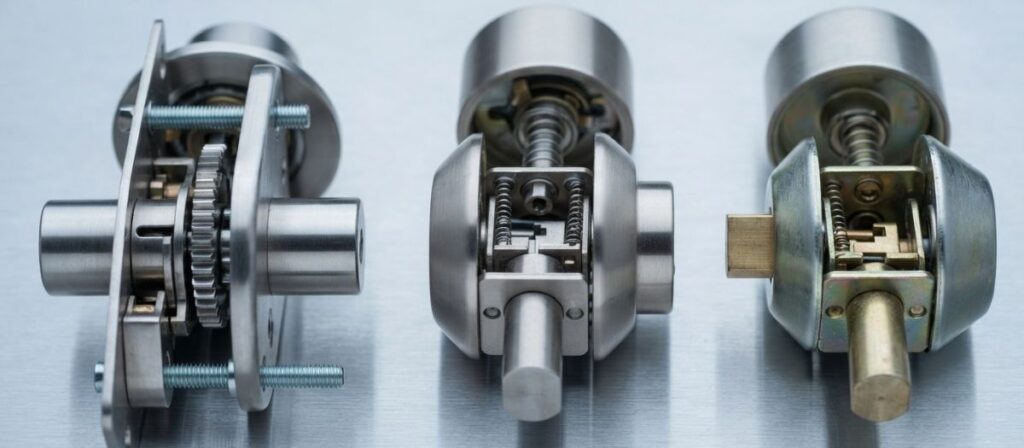
Grade 1: Built for Heavy Commercial Traffic
Grade 1 hardware is the standard for genuine commercial and institutional use. A Grade 1 cylindrical lockset survives at least 800,000 open-close cycles, roughly double what Grade 2 requires. Deadbolts rated Grade 1 typically handle ten strikes at 75 foot-pounds of force without failure, the rough equivalent of a full-force kick from an adult, repeated ten times.
This is the grade appropriate for storefront entries, main office doors, school and hospital entrances, and any door that gets opened hundreds of times a day. In practice, most locksmiths will recommend Grade 1 for any exterior commercial door in a high-traffic corridor, particularly anything near UIUC or Campustown where foot traffic runs consistently higher than a typical suburban office.
Grade 1 hardware costs more upfront, often starting meaningfully higher than Grade 2 equivalents. For a business owner weighing that cost, the calculation is straightforward: a lock that fails prematurely under heavy use costs more in replacement labor and potential liability than the price difference at installation.
Grade 2: Light Commercial and High-End Residential
Grade 2 hardware sits in the middle, built to survive roughly 400,000 cycles and five strikes at 75 foot-pounds. This is genuinely solid hardware, but it’s engineered for lighter use than a busy commercial entrance sees.
Grade 2 fits interior office doors, low-traffic side entrances, and light commercial applications where the door isn’t taking constant abuse. Some competitors present Grade 2 as adequate for any commercial door, which oversimplifies the decision. A Grade 2 lock on an interior conference room door will likely outlast the building. That same Grade 2 lock on a retail front entrance in a high-turnover corridor is likely to show wear, loosening, or reduced reliability well before a Grade 1 unit would.
Grade 3: Light Duty Only
Grade 3 is the minimum standard ANSI recognizes, built to survive around 200,000 cycles and only two strikes at 75 foot-pounds. It’s legal for exterior use in some residential contexts, but it has no real place on a commercial storefront or main entrance.
Grade 3 hardware belongs on genuinely low-risk interior doors: storage closets, low-traffic back offices, or interior doors where forced entry isn’t a realistic concern. If you’re a Champaign County business owner and your exterior door currently has Grade 3 hardware, that’s worth addressing regardless of how the door has performed so far, since the gap between Grade 3 and Grade 2 in real-world durability is significant even though the price difference often isn’t.
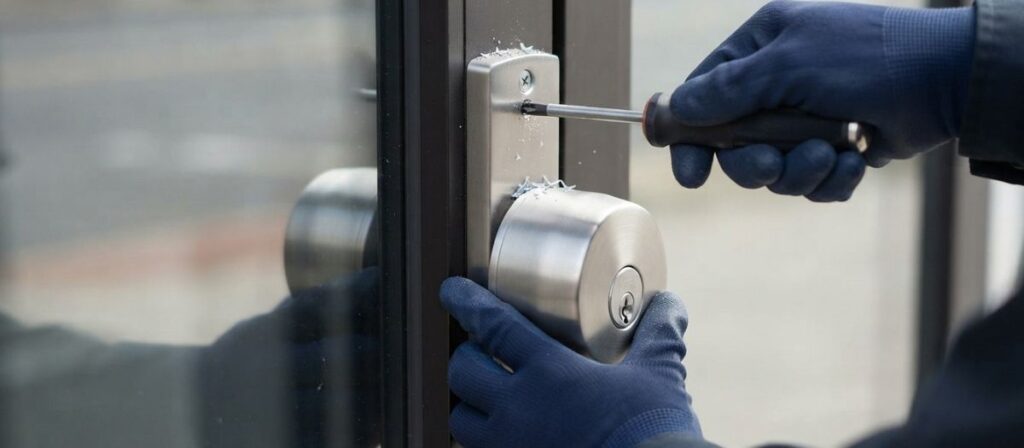
The Lock Grade Is Only Half the Security Equation
This is the detail almost every guide on this topic skips or mentions only in passing, and it’s the single biggest reason commercial hardware underperforms its rating.
A Grade 1 lock installed with the factory strike plate and standard three-quarter-inch screws performs closer to a Grade 2 or Grade 3 lock in practice. The strike plate, the metal bracket the deadbolt extends into, is almost always the weakest point in the entire assembly, not the lock body itself. Short screws that only bite into door trim rather than the structural frame stud behind it give an intruder a much easier failure point to exploit than the lock cylinder ever would.
A strike plate reinforcement upgrade, using a box strike or wraparound plate anchored with three-inch screws that reach the framing stud, closes most of that gap for a modest additional cost and a small amount of extra installation time. For a Champaign County property owner spending money on Grade 1 hardware specifically for its durability rating, skipping this step undercuts a meaningful portion of what that investment was supposed to buy. Ask your locksmith directly whether the strike plate installation matches the grade of the lock you’re paying for, since a mismatch here is common and rarely disclosed upfront.
Insurance and Code Compliance Considerations
This gets mentioned vaguely across competitor content but rarely explained with any specificity. Commercial property and liability insurers sometimes set minimum ANSI grade requirements on exterior doors as a condition of coverage, particularly for retail storefronts, offices with client-facing entrances, or properties in areas with higher reported break-in activity.
If your business experiences a break-in and your exterior hardware falls below what your policy requires or what local building code specifies, that gap can complicate a claim or create liability exposure beyond the immediate loss. This is worth a direct conversation with your insurance agent before hardware gets purchased, not after an incident. Illinois commercial building code requirements can also specify minimum hardware standards depending on occupancy type, particularly for doors that also serve as fire-rated or emergency egress points.
For fire-rated commercial doors specifically, hardware compliance isn’t optional. A door rated for fire resistance loses that rating if the installed hardware isn’t also certified compatible, which matters for any Champaign County business occupying a multi-tenant building or older commercial structure where door assemblies were rated as a complete system.
Panic Bars and Exit Devices Have Their Own Grading Considerations
No competitor content we reviewed addresses this, despite it being common on the exact type of commercial and institutional doors this article is about. Schools, offices, and multi-tenant buildings across Champaign County frequently use panic bars or exit devices on doors that also require ANSI grading, but these carry additional life-safety and fire code considerations beyond a standard lockset’s mechanical rating.
An exit device has to satisfy both the mechanical grade testing and separate egress code requirements, since its primary job is allowing safe exit during an emergency, not just resisting forced entry. If your building has panic hardware on any exterior or corridor door, that hardware needs to meet both standards simultaneously, and a locksmith familiar with commercial and institutional installations should be the one specifying and installing it rather than treating it as a standard lockset swap.
You Don't Need the Same Grade on Every Door
A mistake we see often: business owners assume every door in a building needs identical hardware, which either wastes budget or leaves a weak point unaddressed.
The smarter approach treats grading as a per-door decision based on traffic and risk. Your main storefront entrance, any door facing a public sidewalk or parking area, and doors protecting cash, inventory, or sensitive records justify Grade 1 hardware without question. Interior office doors, low-traffic hallways, and storage areas with no direct exterior exposure can reasonably use Grade 2 hardware without meaningfully increasing your risk. Grade 3 should generally be reserved for interior doors where forced entry simply isn’t a realistic scenario, like a supply closet inside an already-secured office suite.
This tiered approach lets a Champaign County business owner allocate a hardware budget where it actually matters instead of either overspending across the board or, more commonly, underspending on the one door that sees the most traffic and the most risk.
Mistakes Champaign County Property Owners Make With Commercial Lock Grades
A few patterns come up repeatedly in our commercial work locally, and they’re worth addressing directly.
Assuming residential-grade hardware from a big-box store is fine for a commercial entrance. Even hardware labeled Grade 2 at a home improvement store is often built to a lighter standard than genuine commercial Grade 2 hardware sourced through a locksmith or commercial supplier, since consumer-grade products optimize for cost over the heavier-duty materials commercial lines use.
Not accounting for rental property turnover near UIUC. Properties in and around Campustown and near-campus rental corridors see far higher tenant turnover and lock-cycle wear than a typical single-family home. A Grade 2 or Grade 3 lock that would last many years in a stable residential setting wears out faster under that turnover pattern, making Grade 1 hardware on rental exterior doors a genuinely sound investment for landlords managing several units in this specific market.
Ignoring the strike plate during a hardware upgrade. As covered above, this is the single most common gap between a lock’s rated security and its real-world performance, and it’s the cheapest part of the fix to get right.
Waiting for a break-in before upgrading. A door with visibly worn, loose, or mismatched hardware is a signal worth acting on proactively, particularly for any Champaign County business near Carle Foundation Hospital, Downtown Urbana, or other higher-traffic commercial corridors where door hardware sees consistent daily wear.
Frequently Asked Questions
What are the differences between Grade 1 and Grade 3 door locks?
Grade 1 survives roughly four times the open-close cycles of Grade 3 and withstands five times the number of forced-entry strikes. Grade 1 is built for heavy commercial traffic, while Grade 3 is meant for light-duty interior use only.
What are the key differences between Grade 2 and Grade 3 door locks?
Grade 2 handles roughly double the cycles and more than double the strike resistance of Grade 3. Grade 2 suits light commercial and high-end residential doors, while Grade 3 belongs on low-risk interior doors only.
What is the difference between Grade 1 and Grade 2 door hardware?
Grade 1 is tested to withstand double the cycles of Grade 2 and twice as many forced-entry strikes. Grade 1 is the correct choice for high-traffic commercial entrances, while Grade 2 fits lighter commercial or interior applications.
What are the security levels of commercial door locks?
Commercial door locks are graded 1 through 3 under ANSI/BHMA standards, with Grade 1 offering the highest durability and forced-entry resistance, appropriate for main commercial entrances, and Grade 3 offering the least, appropriate only for low-risk interior doors.
What is a Grade 2 lock?
A Grade 2 lock is a mid-tier ANSI-rated lockset built to survive around 400,000 open-close cycles and five forced-entry strikes at 75 foot-pounds, suitable for light commercial use and interior office doors.
What does Grade 3 mean on a lock?
Grade 3 is the lowest ANSI rating, tested to survive around 200,000 cycles and two forced-entry strikes. It’s the minimum standard and is appropriate only for low-traffic interior doors, not commercial entrances.
What is a Grade 1 lock?
A Grade 1 lock is the highest ANSI-rated commercial hardware, tested to survive at least 800,000 cycles and ten forced-entry strikes at 75 foot-pounds, built for high-traffic commercial and institutional doors.
✅ Key Takeaways
Choosing between ANSI grade locks for commercial doors comes down to matching the grade to actual door traffic and risk, not defaulting to the same hardware across every door in a building. Grade 1 belongs on your busiest, most exposed entrances, Grade 2 handles lighter commercial and interior use well, and Grade 3 should stay confined to low-risk interior doors. None of that matters if the strike plate installation doesn’t match the lock’s rating, since that’s where most real-world security gaps actually show up.
If you’re not sure what grade your current commercial hardware carries, or you’re planning an upgrade for a storefront, office, or rental property in Urbana or Champaign County, call Locksmith Urbana IL at (217) 288-2915. We can assess your current doors and recommend hardware that fits your actual traffic and risk, not just the highest-priced option. Visit our Commercial Locksmith Services page to see the full range of commercial hardware and installation work we handle.
- Available Right Now
Dealing With a Lockout Right Now?
Locksmith Urbana IL is available 24 hours a day, every day. Same-day service, upfront pricing, and a local technician who knows the Champaign County area.
Most calls in ZIP 61801 & 61802 see a technician on-site within 35 minutes