
- Commercial Lockout Guide
Panic Bars and Push Bars: What Illinois Fire Code Requires for Businesses
- Locksmith Urbana IL
- 8 min read
- Urbana, IL. 61801 / 61802
A restaurant owner in Downtown Urbana once asked us a simple question: does my building need panic bars? The honest answer took longer than “yes” or “no,” because it depends on occupancy type, occupant load, and sometimes on a single room buried inside an otherwise exempt building. Most articles on panic bar requirements for businesses answer with a generic “50 or more people” rule and stop there. That rule is real, but it’s only part of the picture, and getting it wrong risks a fire marshal citation or, worse, hardware that fails during an actual emergency.
This guide breaks down exactly what Illinois code requires, where the confusion actually comes from, and a few triggers most business owners never think to check.
What Panic Hardware Actually Is
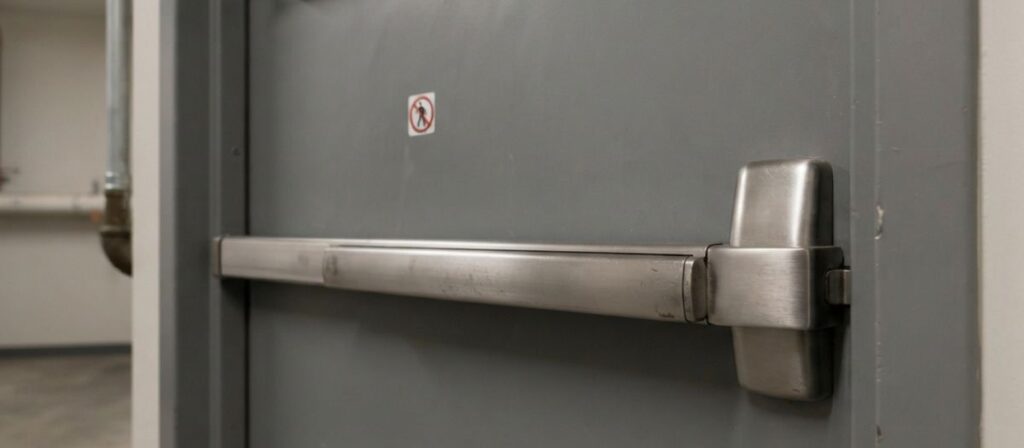
Panic hardware, sometimes called a crash bar or push bar, is a door-latching device that releases when pressure is applied in the direction of exit travel. Push against the bar, and the latch disengages immediately, no twisting, no key, no second motion required. This single-action release is the entire point: in an emergency, people moving toward an exit shouldn’t have to fumble with a mechanism under pressure or in the dark.
Fire exit hardware is a related but distinct category, essentially panic hardware built to also carry a fire rating, so it can be installed on a fire-rated door assembly without compromising that door’s rating. The two terms get used interchangeably in casual conversation, but they aren’t identical products, and specifying the wrong one on a fire-rated door is a compliance gap that’s easy to miss.
Illinois adopts and amends the International Building Code (IBC) for its statewide building code, and Section 1010.2.9 of the Illinois Building Code governs panic and fire exit hardware specifically. Understanding that this is the governing section, rather than relying on generic national blog content built around a different jurisdiction’s code, matters if you’re preparing for an actual Illinois inspection.

The Occupant Load Rule Almost Every Business Owner Gets Wrong
Here’s where most competitor content stops short, and where most confusion actually starts.
Under Illinois Building Code Section 1010.2.9, swinging doors serving a Group A (assembly) or Group E (educational) occupancy with an occupant load of 50 or more can’t be fitted with any latch or lock other than panic hardware or fire exit hardware, if latching hardware is used at all. This is the rule most articles quote, and it’s accurate as far as it goes.
What gets left out: most small businesses in Champaign County aren’t Group A or E occupancies at all. A typical retail shop, standalone office, or professional practice is classified as Group B or Group M, and these occupancy types are not automatically required to install panic hardware based on headcount alone. If you run a straightforward retail storefront or office near Campustown with no assembly space inside, you may genuinely be exempt from the mandatory panic hardware requirement, regardless of how many customers or employees pass through in a day.
The nuance that changes this: occupant load is calculated per room and space, not just per building. A Group B office building that’s otherwise exempt can still trigger the panic hardware requirement if it contains an internal room, a lunchroom, training room, or waiting area, whose own calculated occupant load reaches 50 or more. In that case, the doors serving that specific room, and the doors along the egress path leading out of it, need panic or fire exit hardware even though the rest of the building has no such requirement.
This nested rule is the single most misunderstood part of panic hardware compliance, and it’s the actual answer to “do I need this” for a lot of Champaign County businesses that assume a simple building-type lookup settles the question.
Occupant load itself isn’t based on how many people you think typically use a space. It’s calculated using IBC Table 1004.5, which assigns a square-footage factor per person based on the room’s function, meaning a 900-square-foot assembly space with unconcentrated seating can cross the 50-person threshold on paper even if it rarely feels that full in practice.
The Two Genuinely Obscure Triggers Nobody Talks About
Beyond occupancy type and assembly rooms, Illinois code carries two specific triggers that have nothing to do with how many people use a space, and almost no competitor content mentions either one.
Group H, high-hazard occupancies, require panic or fire exit hardware regardless of occupant load, meaning even a single-occupant space qualifies if it’s classified as high-hazard. This applies to businesses storing or handling hazardous chemicals, certain lab spaces, and similar industrial classifications. If your Champaign County business falls into this category, headcount is irrelevant to whether you need panic hardware.
Rooms with significant electrical equipment carry a separate, specific trigger under Illinois Building Code Section 1010.2.9.2. Exit or exit-access doors serving rooms with electrical equipment rated 800 amperes or more, where the exit door sits within 25 feet of that equipment’s required working space per NFPA 70, must be equipped with panic hardware or fire exit hardware, and the door must swing in the direction of egress travel. This applies to transformer vaults, battery or energy storage rooms, and modular data centers, spaces that exist in some Champaign County commercial and institutional mechanical rooms without anyone realizing this specific hardware requirement applies.
A third, narrower trigger covers refrigeration machinery rooms larger than 1,000 square feet, which must have at least two exit doors swinging in the direction of egress travel, equipped with panic or fire exit hardware. This is a niche case but relevant for any Champaign County business running commercial refrigeration or cold storage at scale.
Installation Specifications That Matter for Compliance
Meeting the occupancy trigger is only half the requirement. Illinois code also specifies exactly how the hardware itself must be installed.
Panic hardware must be listed in accordance with UL 305, and fire exit hardware must carry both UL 10C and UL 305 listings. This isn’t a suggestion, using unlisted hardware on a door that legally requires panic hardware doesn’t satisfy the code requirement even if the device looks and functions similarly.
The actuating bar or push pad must extend at least half the width of the door leaf, and mounting height falls between 34 and 48 inches above the finished floor. The maximum force required to release the latch can’t exceed 15 pounds, ensuring the device genuinely functions as a low-effort emergency release rather than something that could jam or resist under panic conditions.
Balanced doors, a less common door type using a pivot point offset from the edge, have their own specific rule: if panic hardware is required, it must be the push-pad type, and the pad can’t extend more than half the door’s width measured from the latch side.
Doors equipped with proper panic hardware also can’t carry an additional locking device, like a chain or padlock, that would prevent someone from opening the door from the inside. Illinois code does allow certain delayed egress or controlled egress locking mechanisms in specific contexts, security measures that trigger a brief alarm delay before release, commonly used in settings like assisted living facilities where unsupervised exit poses its own risk. These are narrow exceptions requiring their own compliance path, not a workaround for a business that simply wants added security on an otherwise standard exit door.
What Most Panic Bar Guides Don't Tell You
A handful of practical realities get skipped by almost every article covering this topic, and they matter specifically for Champaign County businesses.
Grade matters as much as compliance. Illinois code requires listed panic hardware, but it doesn’t dictate ANSI/BHMA grade directly, that’s a durability and reliability decision layered on top of the legal minimum. For a high-traffic assembly or educational occupancy, specifying Grade 1 exit devices over Grade 2 isn’t just a durability upgrade, it’s a real-world reliability question during an actual emergency, when hardware that’s been cycled hundreds of thousands of times needs to work correctly on the first try. Our Lock Security Grades for Commercial Doors blog covers what separates those grades in more depth.
Older Downtown Urbana buildings often need modification, not just installation. Historic and older commercial buildings around Downtown Urbana and Campustown frequently have door frames and leaf widths that predate standard exit device dimensions. Installing code-compliant panic hardware on these doors sometimes requires frame modification or a different device configuration than a newer commercial building would need, which adds cost and time that a straightforward new-construction install wouldn’t involve. Budget for an on-site assessment rather than assuming a standard device will fit without adjustment.
A rekey or hardware change is a compliance checkpoint, not just a security decision. If you’re rekeying or replacing hardware on a door that’s part of a designated egress path, that’s the moment to confirm the replacement hardware still satisfies whatever panic hardware trigger applies to that door. Rekeying for Commercial Properties After Employee Turnover blog touches on this from the security side; this is the code-compliance side of that same moment.
Panic hardware can integrate with access control, using electric latch retraction to allow the door to remain electronically secured from the outside while always releasing freely from the inside under panic hardware operation. This lets a business maintain access control security without compromising code-required free egress, a detail that matters for Champaign County offices and institutional buildings running electronic access systems.
Frequently Asked Questions
Where is panic hardware required by Illinois code?
Panic or fire exit hardware is required on swinging doors serving Group A or E occupancies with an occupant load of 50 or more, on Group H high-hazard occupancies regardless of occupant load, and on specific doors serving electrical equipment rooms, refrigeration machinery rooms, and similar specialized spaces under Illinois Building Code Section 1010.2.9.
Are push bars required on all exit doors?
No. Push bars, another term for panic hardware, are only legally required on doors meeting a specific occupancy and occupant load trigger, or on doors serving certain high-hazard or specialized spaces. Many small business exit doors are not required to have panic hardware at all.
What are the panic hardware requirements for an electrical room?
Exit or exit-access doors serving rooms with electrical equipment rated 800 amperes or more, within 25 feet of the equipment’s required working space, must have panic hardware or fire exit hardware and must swing in the direction of egress travel, per Illinois Building Code Section 1010.2.9.2.
What occupant load requires panic hardware in a business building?
For Group A and E occupancies, the threshold is 50 or more occupants. Group B and M business occupancies aren’t automatically required to install panic hardware based on occupant count, unless an internal room within that building independently reaches the 50-person threshold.
Do fire exit doors need panic bars?
Doors classified as required means-of-egress doors under a qualifying occupancy or hazard trigger need panic hardware or fire exit hardware specifically, not just any latch. Fire-rated doors specifically need fire exit hardware, which carries an additional fire-resistance listing beyond standard panic hardware.
Can a panic bar be installed on any door?
Physically, panic hardware can be installed on most commercial door types, but it needs to match the door’s fire rating and dimensions. A fire-rated door requires fire exit hardware specifically, and older or non-standard door frames sometimes need modification to accept standard hardware correctly.
Can a panic bar be locked?
The interior release mechanism itself can never be blocked by an additional lock, chain, or padlock. However, the exterior side can be secured through compatible locking or access control systems, and specific settings allow delayed or controlled egress locking under narrow, code-defined circumstances.
What is a panic push bar and how much does installation cost in Champaign County?
A panic push bar is a horizontal bar mounted across a door’s interior that releases the latch under light pressure in the direction of exit travel. Installation cost depends on device type, door material, and whether the existing frame needs modification, a locksmith can give an accurate quote after assessing your specific door and occupancy requirements.
✅ Key Takeaways
Panic bar requirements for businesses in Illinois hinge on occupancy classification, calculated occupant load, and a handful of specialized triggers tied to hazard level and electrical equipment, not a simple headcount rule that applies uniformly to every building. A Group B office that seems exempt on paper can still need panic hardware on doors serving one internal room, and older Downtown Urbana buildings often need more than a standard installation to get there.
If you’re not sure whether your Champaign County business needs panic hardware, or which doors specifically require it, call Locksmith Urbana IL at (217) 288-2915. We can assess your occupancy, calculate room-by-room occupant loads, and recommend hardware that satisfies both code and real-world reliability. Visit our Commercial Locksmith Services page to see the full range of commercial compliance work we handle.
- Available Right Now
Dealing With a Lockout Right Now?
Locksmith Urbana IL is available 24 hours a day, every day. Same-day service, upfront pricing, and a local technician who knows the Champaign County area.
Most calls in ZIP 61801 & 61802 see a technician on-site within 35 minutes