
- Commercial Lockout Guide
Electric Strike vs Magnetic Lock: Which Access Control Method Is Right for You
- Locksmith Urbana IL
- 8 min read
- Urbana, IL. 61801 / 61802
The question isn’t really which hardware is “better.” It’s which failure behavior you want on a specific door when the power goes out, and that’s exactly the question most articles on electric strike vs magnetic lock skip past on their way to a generic feature comparison. A maglock on your main entrance and an electric strike on your server room aren’t interchangeable choices, they solve different problems by design.
This guide walks through how each mechanism actually works, why the choice depends more on what should happen during a power failure than on price or brand, and a few installation realities that matter specifically for older Champaign County commercial buildings.
How Each Mechanism Actually Works
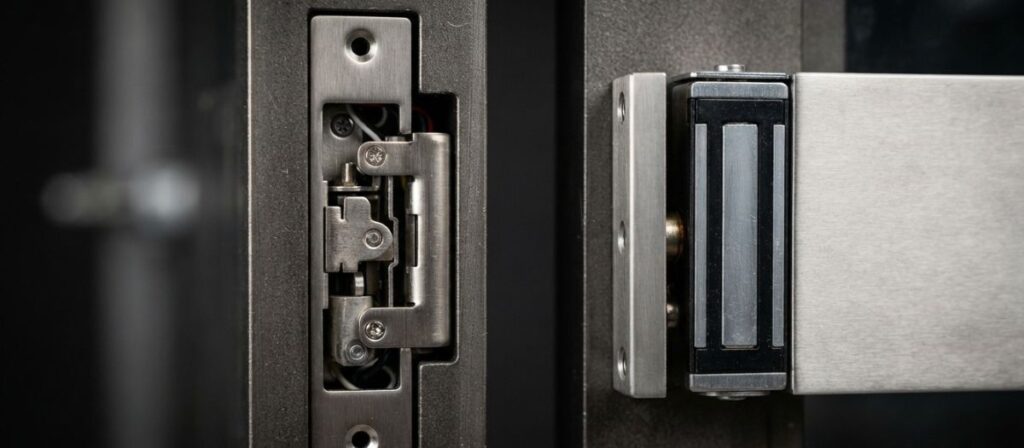
An electric strike replaces the standard strike plate in your door frame. It still works alongside your existing mechanical lockset, deadbolt or latch included. When a valid credential is presented, a solenoid inside the strike releases the keeper, allowing the latch to swing free so the door opens. The door itself stays mechanically latched at all other times, the strike is only doing its job for a brief moment during entry.
A magnetic lock, or maglock, works on a completely different principle. An electromagnet mounts on the door frame, and a metal armature plate mounts on the door itself. As long as power flows to the magnet, the two surfaces hold together with a rated holding force, often up to 1,200 pounds on a heavy-duty unit. There’s no latch, no mechanical lock body involved at all. Cut the power, and the magnetic bond releases entirely.
This distinction, latch-based versus full-surface holding, is the real mechanical difference underneath everything else in this comparison, and it’s why the two devices behave so differently when something goes wrong.
Fail-Safe vs Fail-Secure: Match It to the Door, Not the Building
Every competitor article defines fail-safe and fail-secure as neutral technical terms. What almost none of them do is walk through what that behavior actually means for a specific door during a power outage, which is the only question that matters when you’re deciding.
Maglocks are inherently fail-safe. They require continuous power to stay locked, so when power is lost, whether from an outage, a fire alarm trigger, or a system failure, the door unlocks automatically. This is exactly the behavior required on doors along a designated egress path, since life safety code generally requires those doors to release freely during an emergency, regardless of power state.
Electric strikes can be configured either way. A fail-secure strike stays locked when power is lost, meaning the door remains secured even during an outage, though people already inside can typically still exit by turning the interior handle mechanically. A fail-safe strike, by contrast, unlocks like a maglock would.
Here’s the decision framework competitors gloss over: don’t pick a lock type first and figure out the failure mode second. Start with what should happen on that specific door during a power loss. A main entrance or any door on a required egress path needs fail-safe behavior, pointing toward either a maglock or a fail-safe electric strike. An interior server room, a records room, or a storage area holding valuable inventory usually needs fail-secure behavior, meaning it should stay locked during an outage rather than unlock automatically, which points toward a fail-secure electric strike. Treating this as a per-door decision, not a single building-wide choice, is the framework a Champaign County business owner actually needs.
Why Panic-Hardware Doors Almost Always Rule Out a Standard Maglock
This connection gets mentioned briefly by one competitor source and explained by none of them, despite being directly relevant to any door equipped with panic hardware.
A standard maglock holds the entire door shut through magnetic force alone, with no mechanical latch involved. That conflicts with free-egress requirements on doors that also carry panic hardware, since panic bars are designed to release the door with a single push motion from the interior, and a maglock’s holding force sits outside that mechanism entirely. Panic Bars and Push Bars blog covers the Illinois code requirements driving this in more depth, but the practical takeaway here is that a door requiring panic hardware generally needs either an electric strike paired with the mechanical lockset, or a specialized electric latch retraction panic bar that integrates access control directly into the exit device itself, rather than a standalone maglock holding the whole door.
If your building has any door that’s both access-controlled and equipped with panic hardware, that’s a strong early signal pointing away from a simple maglock installation and toward a more integrated hardware solution.
The Hidden Equipment Layer: REX Sensors and Door Monitoring
This is a genuine technical gap in nearly every competitor article, and it affects both installation cost and long-term reliability.
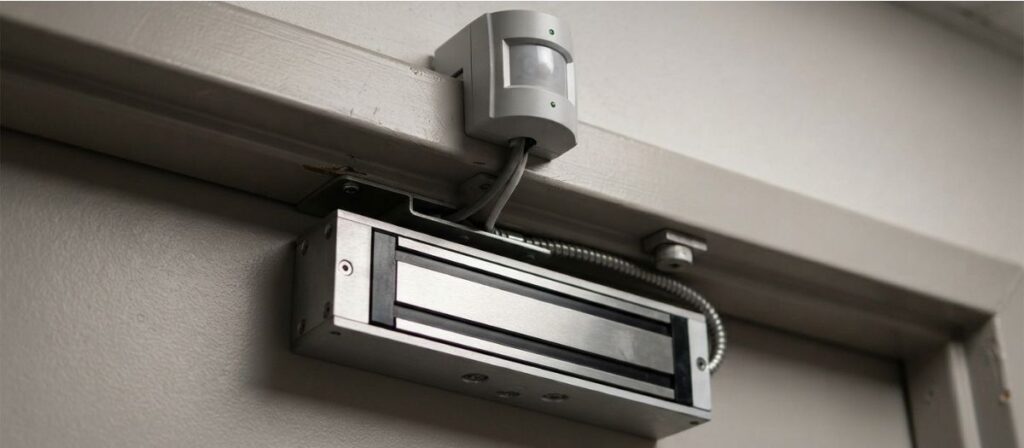
Because a maglock has no mechanical latch to release from the inside, exiting through a maglocked door requires either a request-to-exit (REX) sensor, a motion sensor mounted above the door that detects someone approaching from inside and releases the lock automatically, or a manual push button wired into the system. This is an additional piece of equipment and wiring beyond the lock itself, adding to both material and labor cost.
Electric strikes generally avoid this extra layer, since they work with the existing door handle or lever. Someone exiting simply turns the interior handle as they normally would, no additional sensor required for basic exit function. In practice, most locksmiths quote maglock installations with this REX requirement built in from the start, but it’s worth knowing upfront if you’re comparing sticker prices between the two hardware types, since an apples-to-apples cost comparison needs to include this equipment on the maglock side.
Retrofit Reality for Older Champaign County Buildings
No competitor connects this comparison to the specific challenge of older commercial building stock, which is common around Downtown Urbana and Campustown.
An electric strike is generally the friendlier retrofit option because it works with hardware that’s likely already installed. If your existing mechanical lockset and door frame are in reasonable condition, a locksmith can often swap in an electric strike without major modification to the door or frame itself.
A maglock retrofit is a different undertaking. Because the electromagnet and armature plate need near-perfect surface contact to achieve their rated holding force, installation is genuinely more sensitive to door and frame alignment than an electric strike is. Older doors and frames that have settled or shifted over decades, which is common in Downtown Urbana’s older commercial buildings, sometimes need additional bracket work, header reinforcement, or frame adjustment to get a maglock properly seated. An electric strike has meaningfully more mechanical tolerance for a slightly imperfect frame, since the strike only needs to align with the latch, not hold the entire door through surface contact.
If you’re evaluating access control for an older building in this area, budget for an on-site assessment before assuming either hardware type will install cleanly, since the condition of your specific door and frame genuinely changes both the cost and the better-suited option.
Power Outages and What Actually Happens
This is a practical, locally relevant angle no competitor addresses, and it matters given how often Central Illinois sees storm-related outages.
During a power outage without battery backup, a fail-secure electric strike stays locked, meaning credentialed access through the reader stops working, but the door remains secured from unauthorized entry. A fail-safe maglock, without battery backup, unlocks entirely the moment power is lost, which is exactly the behavior you want on an egress door but genuinely changes the security posture of any other door running the same configuration.
Battery backup addresses this gap for both hardware types, keeping the system operational through short outages, but it’s an added cost and a component that needs periodic testing and replacement to stay reliable. For a Champaign County business weighing maglocks on doors that aren’t egress-related, this is worth factoring in directly: a maglock without backup power on a non-egress door means that door effectively becomes unsecured during every outage, which may or may not be an acceptable trade-off depending on what that door protects.
Mistakes Champaign County Businesses Make Choosing Between These Systems
A handful of patterns show up repeatedly in local commercial access control work.
Choosing hardware type before defining failure behavior. As covered above, the door’s required failure behavior should drive the hardware choice, not the reverse. Picking a maglock because it seems like the more “high-tech” option, without confirming it satisfies egress requirements for that specific door, is a compliance risk waiting to surface at inspection.
Underestimating maglock installation complexity on older doors. Assuming a maglock installs as simply as an electric strike, without accounting for door and frame alignment sensitivity, leads to unexpected costs once a technician is actually on-site assessing the door.
Forgetting that an electric strike still depends on the underlying lock body’s grade. An electric strike controls access at the frame, but the mechanical lockset it pairs with still has its own ANSI/BHMA grade rating, and that rating still matters for the door’s overall durability and security. Lock Security Grades for Commercial Doors blog covers what those grade differences actually mean.
Skipping battery backup on doors where an outage-driven unlock is a real risk. This is especially relevant during Central Illinois storm season, when extended outages happen with some regularity. A brief conversation about backup power during system design prevents a security gap nobody planned for.
Frequently Asked Questions
When should I use a maglock vs an electric strike?
Use a maglock on doors requiring fail-safe behavior, typically main entrances or egress paths where the door must unlock during a power loss or fire alarm. Use an electric strike, generally in fail-secure configuration, on interior doors like server rooms or storage areas where staying locked during an outage is the safer default.
Which type of lock is the most secure?
Neither is universally more secure, it depends on the door’s role. A maglock offers strong holding force while powered, but a fail-secure electric strike keeps a door locked during outages, which some businesses consider more secure for non-egress, high-value areas.
What are the disadvantages of maglocks?
They require constant power to stay locked, add installation complexity through REX sensors and door position monitoring, are more sensitive to door and frame alignment, and generally aren’t suitable for doors equipped with standard panic hardware.
Is an electric lock the same thing as an electric strike?
Not exactly. “Electric lock” is a broader term covering several access control mechanisms, including electric strikes, maglocks, and electrified locksets. An electric strike specifically refers to the frame-mounted device that releases a mechanical latch.
What are common problems with electric strikes?
Misalignment with the latch, wiring issues affecting the solenoid, and door closer tension that’s too strong or too weak for the strike’s release timing are among the most common issues, most of which a locksmith can diagnose and correct during a service visit.
Why is my electric strike not locking?
This is often a wiring fault, an incorrectly configured fail-safe versus fail-secure setting, or physical misalignment between the strike and the latch. A locksmith can test the strike’s power connection and mechanical fit to identify the specific cause.
Can an electric strike be fail-safe? Can an electric strike be fail-safe?
Yes. Unlike maglocks, which are inherently fail-safe by design, electric strikes can be configured as either fail-safe or fail-secure depending on the manufacturer and model, giving more flexibility to match the specific door’s requirements.
✅ Key Takeaways
Choosing between electric strike vs magnetic lock comes down to matching failure behavior to what each specific door actually needs, not picking one system for an entire building. Maglocks suit fail-safe egress doors but add installation complexity and REX sensor requirements; electric strikes offer more retrofit flexibility and fail-secure options for doors that should stay locked during an outage.
If you’re planning access control for a Champaign County business and aren’t sure which hardware fits your specific doors, call Locksmith Urbana IL at (217) 288-2915. We’ll assess your door types, egress requirements, and power setup before recommending hardware, not the other way around. Visit our Commercial Locksmith Services page to see the full range of access control work we handle.
- Available Right Now
Dealing With a Lockout Right Now?
Locksmith Urbana IL is available 24 hours a day, every day. Same-day service, upfront pricing, and a local technician who knows the Champaign County area.
Most calls in ZIP 61801 & 61802 see a technician on-site within 35 minutes