
- Access Control System Guide
What Is an Access Control System and Does Your Urbana Business Need One
- Locksmith Urbana IL
- 8 min read
- Urbana, IL. 61801 / 61802
A former employee whose key was never returned. A back door propped open during a delivery rush. A records room nobody’s tracked access to in years. These are the everyday gaps an access control system for business actually closes, not the dramatic break-in scenario most marketing leads with.
But the question this article actually answers, one almost every competitor skips, is whether your specific Urbana business needs one at all, or whether a well-designed mechanical system solves the same problem for less money and less complexity.
What an Access Control System Actually Does
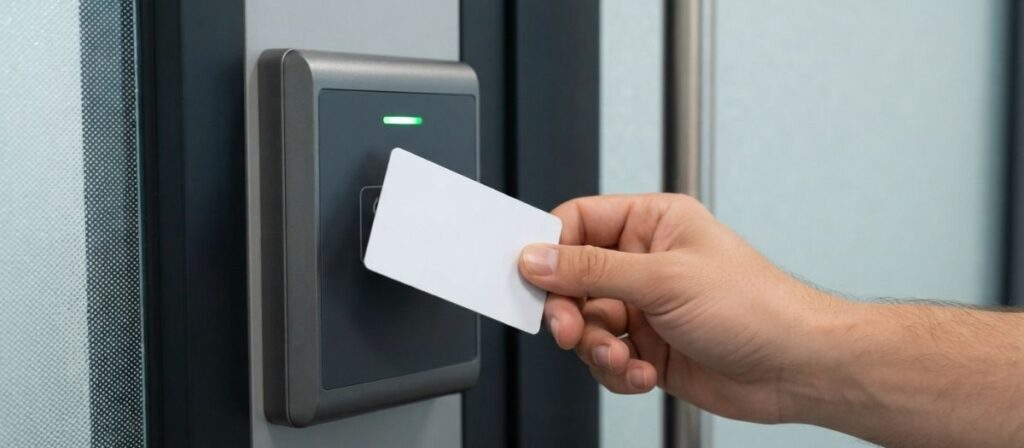
At its core, an access control system makes a decision at the door. An employee presents a credential, a keycard, fob, PIN code, mobile phone, or fingerprint, and a reader sends that information to a controller or cloud-based platform, which checks whether that person has permission to enter that specific door at that specific time. If the credential is valid, the system releases the lock. If not, the door stays secured.
This differs from a traditional key in one fundamental way: the system tracks and controls access actively rather than passively. With a physical key, once it’s cut and handed out, you have limited visibility into who’s used it, when, or whether a copy exists. With an access control system, every access event is logged, timestamped, and traceable, and permissions can be changed or revoked instantly without touching the door hardware itself.
This isn’t limited to exterior entrances. Many Champaign County businesses use access control to secure server rooms, records storage, pharmacy areas, and other internal spaces where a general staff key would be too broad, tiering access based on role rather than an all-or-nothing key.
Do You Actually Need One? A Real Decision Framework
Every competitor article we reviewed lists access control’s benefits as if the answer is automatically yes for every business. It isn’t, and a Champaign County business owner deserves an honest framework rather than a feature list assuming the sale.
Staff turnover frequency is the single biggest factor. A business with stable, long-term staff and rare departures may find that rekeying occasionally, covered in our Commercial Rekeying After Employee Turnover blog, handles the security gap adequately and affordably. A business near UIUC and Campustown relying heavily on student employees, facing constant turnover around graduation, semester breaks, and summer staffing changes, faces a genuinely different calculus. Rekeying every time a student employee leaves becomes expensive and disruptive quickly, while an access control system deactivates that person’s credential in seconds with zero hardware changes.
Number of doors and access tiers needed matters too. A single-entrance small office with three or four employees who all need identical access has less to gain from a full system than a multi-door facility where different staff, cleaning crews, contractors, and management legitimately need different levels of access.
Compliance or audit needs push the decision further. Medical offices near Carle Foundation Hospital, financial services, or businesses handling sensitive client records sometimes need documented proof of who accessed a specific area and when, something a mechanical key simply can’t provide. If your business operates under any regulatory framework requiring access documentation, that alone often justifies the investment regardless of turnover or door count.
If your business checks none of these boxes, low turnover, few doors, no compliance pressure, a well-designed mechanical system is a legitimate, more affordable answer. Master Key Systems Explained blog covers how that mechanical hierarchy works if that’s the better fit for your situation.
The Honest Cost Comparison Nobody Selling Access Control Makes
This is the gap in nearly every competitor article, and it’s an obvious one once you notice it: companies selling access control systems don’t compare their own product’s ongoing costs against the mechanical alternative.
An access control system carries costs beyond the initial hardware and installation: software subscriptions or licensing fees for cloud-based management platforms, occasional technical support, and credential replacement when a card or fob is lost. These are recurring costs that continue for as long as the system operates.
A high-security master key system, by contrast, is largely a one-time installation cost, with ongoing expense limited to occasional rekeying when genuinely warranted. For a small Champaign County business with low turnover and a handful of doors, a well-designed mechanical system with tight key control, restricted keyways, a documented signature list, can solve the same core problem, unauthorized access and lost key exposure, for meaningfully less money over several years.
The honest answer is that access control earns its ongoing cost specifically when turnover, door count, or compliance needs make the recurring expense worth it. For businesses where none of those pressures are significant, the mechanical alternative deserves serious consideration rather than being dismissed as outdated.
Installation Realities
One competitor briefly notes that access control “is not a DIY job” without ever explaining why. Here’s what that actually means before you request a quote.
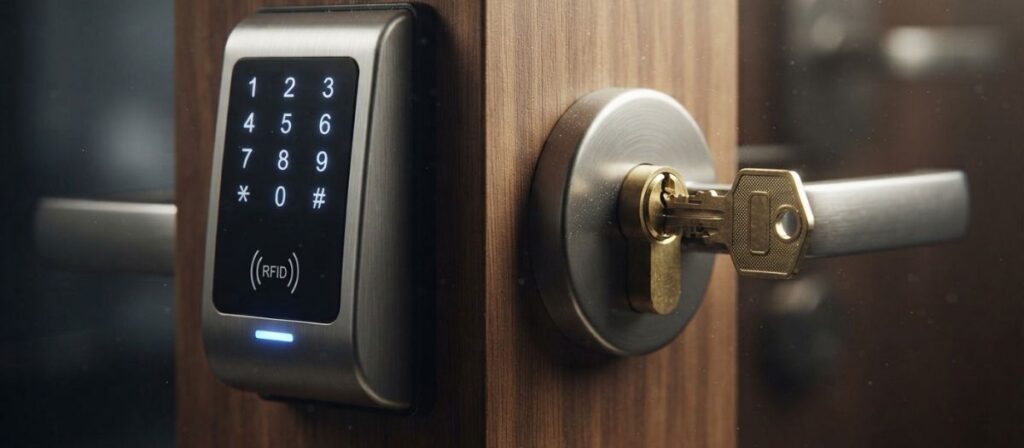
Access control hardware requires low-voltage wiring run to each controlled door, connecting the reader, the controller, and the electronic locking hardware, whether that’s an electric strike or a maglock. Electric Strike vs Magnetic Lock blog covers what that underlying hardware actually does and how it’s chosen. Power supply sizing matters too, since a system controlling multiple doors needs adequate power distribution, not just a single outlet near the reader.
For older commercial buildings around Downtown Urbana, retrofitting access control sometimes means running new wiring through walls or ceilings that weren’t built with this in mind, which adds labor and cost beyond the hardware itself. A locksmith or installer should walk your specific building before quoting, since assuming a straightforward install without seeing the door count, wiring paths, and existing hardware compatibility risks an inaccurate estimate.
Access Control and Fire Code: The Egress Requirement Doesn't Disappear
This connects directly to a compliance point most competitor content never raises. If a door is both access-controlled and equipped with panic hardware, or serves as part of a required egress path, adding credentials to that door doesn’t change Illinois’s free-egress requirements. Panic Bars and Push Bars blog covers what those requirements actually specify.
In practice, this means an access-controlled door on an egress path still has to release freely from the inside with a single motion, regardless of whether someone has a valid credential. This is typically handled through request-to-exit sensors or by pairing access control with panic hardware that includes electric latch retraction, allowing external credential-based entry while never restricting interior exit. A properly designed system accounts for this from the start; retrofitting it in after installation because it was overlooked is a more expensive and disruptive fix.
What Most Access Control Guides Don't Tell You
A few practical realities get glossed over across the content we reviewed.
Cloud-based management isn’t automatically the right choice. Competitor articles tend to present cloud management as a universal upgrade, but a business with specific network reliability concerns, or one operating in an area where internet service isn’t perfectly consistent, may find a locally managed system more dependable day to day. This is worth discussing directly with whoever installs your system rather than defaulting to whatever’s marketed as newest.
Not every door needs the same credential type. A biometric reader on every interior door is often overkill and adds cost without meaningful benefit. Reserving stronger verification, a card plus a PIN, for instance, for genuinely sensitive areas while using simple card or fob access elsewhere allocates budget more sensibly.
Audit trails support liability protection, not just security monitoring. If an incident occurs on your property, whether a theft, an accident, or a dispute about who was present at a given time, documented access logs can provide real evidence supporting your account of events. This liability benefit is separate from, and often as valuable as, the access control itself.
Scalability matters for growing Champaign County businesses. A system that can add doors and users without a full redesign is worth the modest additional planning cost upfront, particularly for a business that expects to add locations or expand its footprint within Urbana or the broader county.
Frequently Asked Questions
What is an access control system in simple terms?
It’s a security system that uses credentials, like keycards, PIN codes, or fingerprints, along with door hardware and software to control who can enter specific areas of a building and when, replacing or supplementing traditional keys.
What are the main types of access control models?
The most common models are discretionary access control, where the business owner sets permissions directly, role-based access control, where permissions are tied to a person’s job function, and rule-based access control, where access depends on predefined conditions like time of day.
What's required to install an access control system?
You need compatible door hardware (an electric strike or maglock), a credential reader, a controller, low-voltage wiring connecting these components, and management software to assign and adjust user permissions.
What are the benefits of access control for a small Champaign County business?
The main benefits are instant credential deactivation when staff leave, detailed access logs for security and liability purposes, and the ability to adjust who can access which doors without physically rekeying locks.
Is access control worth it for a business with only a few employees?
It depends on turnover and compliance needs more than employee count. A small, stable-staff business may be better served by a well-designed mechanical master key system, while a small business with frequent turnover or compliance requirements may still benefit significantly.
How much does an access control system cost for a small business in Urbana IL?
Cost depends on door count, credential type, and whether cloud-based management is included, plus ongoing software or subscription fees. A locksmith or installer can give an accurate quote after assessing your specific building and door count.
Does access control replace the need for physical locks entirely?
No. Access control typically integrates with an underlying lock mechanism, like an electric strike, rather than replacing the mechanical lock body entirely, and doors on required egress paths still need to satisfy free-exit requirements regardless of the credential system used.
✅ Key Takeaways
An access control system for business genuinely solves problems mechanical keys can’t, instant credential deactivation, detailed access logging, and flexible permission tiers, but it isn’t automatically the right choice for every Champaign County business. The honest decision comes down to your specific turnover rate, door count, and compliance needs, weighed against the ongoing cost of a system versus a well-designed mechanical alternative.
If you’re trying to decide whether access control makes sense for your Urbana business, or want a straightforward comparison against a mechanical master key system, call Locksmith Urbana IL at (217) 288-2915. We’ll walk your property, look at your actual turnover and door count, and recommend what genuinely fits rather than defaulting to the most expensive option. Visit our Access Control Locksmith Services page to see the full range of security work we handle.
- Available Right Now
Dealing With a Lockout Right Now?
Locksmith Urbana IL is available 24 hours a day, every day. Same-day service, upfront pricing, and a local technician who knows the Champaign County area.
Most calls in ZIP 61801 & 61802 see a technician on-site within 35 minutes