
- Commercial Lockout Guide
Office Lockout in Urbana IL: What Business Owners Need to Know
- Locksmith Urbana IL
- 8 min read
- Urbana, IL. 61801 / 61802
A locked office door isn’t just an inconvenience. It’s lost revenue for every minute a retail storefront stays dark, a missed morning for a medical office near Carle Foundation Hospital, or a security exposure if the lockout happens after hours with inventory or records inside. Office lockout services solve the immediate problem, but the questions that actually matter, who a locksmith should let in, how multi-tenant buildings complicate things, and how to make sure this doesn’t happen again, rarely get real answers.
This guide covers what business owners in Urbana and across Champaign County need to know before, during, and after an office lockout.
The Verification Step Almost Nobody Talks About
Here’s something every competitor site skips entirely, and it matters more for a business lockout than a residential one: a locksmith unlocking the wrong person into your business is a real liability problem, not just an awkward mistake.
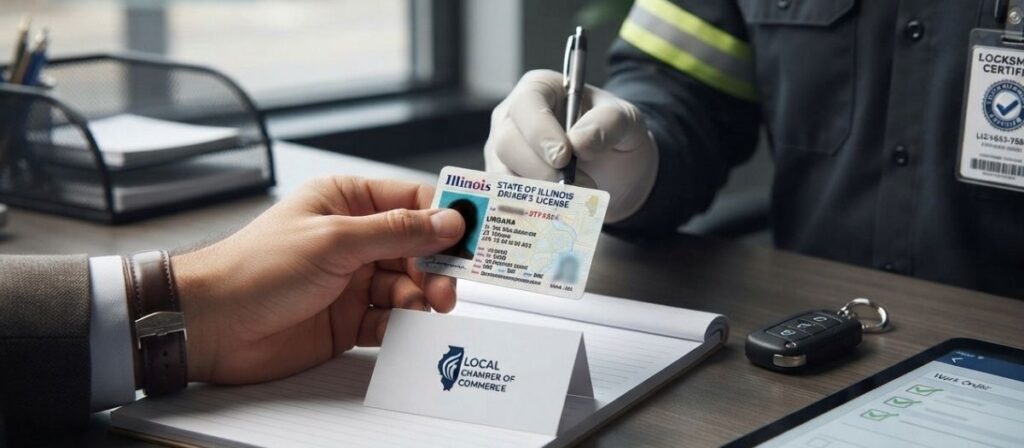
Unlike a home lockout, where a locksmith can reasonably rely on someone knowing the address and describing the interior, a commercial space often has multiple people with legitimate reasons to be there, and not all of them should be the one authorizing entry. In practice, most locksmiths will ask for some combination of a business card or ID matching the signage on the door, direct phone confirmation from the business owner or a manager on file, or property manager verification if the space is leased within a larger building.
If you’re a business owner, it’s worth deciding in advance who on your staff is authorized to call a locksmith and get let in without your direct confirmation, rather than leaving that judgment call to whoever happens to answer the phone during an actual lockout. This is a policy decision, not something to figure out at the moment.
Owner Lockout vs Employee Lockout: Different Situations
Most competitor content treats every office lockout as an identical event. In practice, who’s locked out changes both the urgency and the authorization question.
An owner locked out of their own business is usually the most straightforward case, since ownership itself is generally the clearest form of authorization once verified. An employee locked out during a shift, arriving early to open before other staff, or trying to close alone at night, is a different situation. Should a locksmith open the business based on an employee’s word alone, without reaching the owner directly?
There’s no universal right answer, but there is a right process: decide this ahead of time as part of your business’s access policy. Some owners are comfortable authorizing any employee with a key or badge history to request entry on the business’s behalf. Others require a manager-level confirmation call before a locksmith proceeds, particularly for late-night lockouts when the risk of a socially engineered break-in attempt, however rare, is higher than during business hours. Whichever standard you choose, put it in writing somewhere your staff can reference, rather than leaving it to whoever’s on shift to decide under pressure.
Multi-Tenant Office Buildings Add a Layer Competitors Don't Explain
If your business operates out of a shared office building, common throughout Downtown Urbana and near Campustown, an office lockout often isn’t just one locked door. It can involve a locked suite entrance plus a separately locked building entrance, and sometimes a property management access system your business doesn’t directly control.
This matters for both response time and process. A locksmith arriving at a multi-tenant building may need to coordinate with the property manager before even reaching your suite door, particularly after hours when the building’s main entrance is also secured. If your lease includes specific terms about who can authorize lock work on your suite, or whether the landlord needs to be notified, that’s worth knowing before a lockout happens rather than discovering it while standing outside your own office.
Businesses in shared buildings also sometimes share a master key system with the landlord or building management. If that’s the case, a lockout on your suite door might be resolvable faster through property management than through an independent locksmith call, or it might require both parties involved depending on how the master key hierarchy is set up. Master Key Systems Explained blog covers how that hierarchy works if you’re unsure whether your building uses one.
Physical Lockout vs Access Control Malfunction
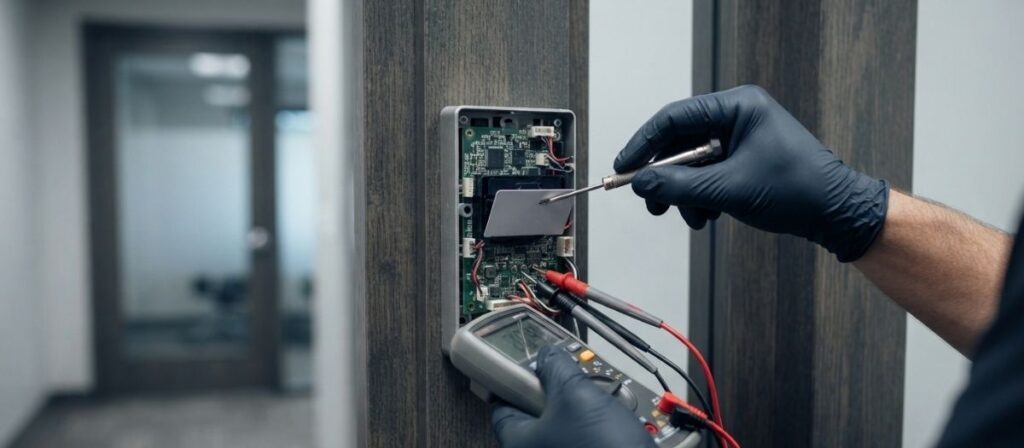
Not every lockout involves a stuck key or a lost set. A growing number of Champaign County offices use keycard readers or keypad access control, and when that system fails, the diagnostic approach is genuinely different from a traditional mechanical lockout.
A malfunctioning keycard reader or keypad might mean a dead battery in the reader itself, a power issue affecting the whole system, a software or credential database problem, or a failed electric strike or maglock component. A locksmith addressing this needs different expertise than one handling a jammed mechanical lock, and diagnosing the actual point of failure matters before assuming the whole system needs replacement. Electric Strike vs Magnetic Lock blog covers the mechanics of these systems in more depth if your business is considering or currently running electronic access control.
If your office has never had this kind of failure before and it happens suddenly, it’s worth checking whether it’s isolated to one door or reader before assuming a bigger system problem, since a single component failure is a much smaller and faster fix than troubleshooting an entire access control panel.
Why Winter Makes Office Lockouts More Common
This is a seasonal, genuinely local factor that doesn’t get mentioned in national or Chicago-focused competitor content. Central Illinois winters cause commercial-grade locks, particularly older mortise locks and exterior storefront hardware, to stiffen in cold temperatures, sometimes badly enough that a key that turned fine the day before suddenly won’t budge.
This matters because what feels like a sudden lockout emergency is sometimes actually a sticking lock that’s been getting progressively harder to turn for weeks, finally failing on a cold morning. If your office door has felt increasingly stiff heading into winter, that’s worth having looked at proactively rather than waiting for it to fully seize on a morning when you’re trying to open for customers or staff.
What Most Office Lockout Guides Don't Tell You
A few things get consistently skipped or oversimplified across the content we reviewed.
A lockout is sometimes the first sign of a bigger security gap, not just a hardware failure. If your office was locked out because a former employee’s key or access credential still worked when it shouldn’t have, the immediate lockout is the smaller problem. The larger issue is that your business’s access control wasn’t updated when that person’s employment ended. Rekeying for Commercial Properties After Employee Turnover blog covers what should happen in that specific scenario.
Rekeying after a lockout isn’t automatic, but it’s often worth doing anyway. If your lockout happened because a key broke, was lost, or a lock malfunctioned, that’s a natural moment to evaluate whether your existing hardware still meets your business’s needs, not just get back through the door and move on. A locksmith who only unlocks the door without asking why it happened is doing half the job.
A prolonged lockout carries real security exposure, not just lost time. A business with visible inventory, cash, or sensitive records that’s locked out for an extended period is also a business that’s temporarily easier to target if word gets around that the space is inaccessible to its own staff. Prioritizing a fast, verified response isn’t just about convenience, it’s about minimizing that exposure window.
Building a Lockout Prevention Policy for Your Business
Since lockouts are genuinely preventable with basic planning, and this article’s audience is business owners rather than someone locked out right now, it’s worth outlining what a real prevention policy looks like.
Decide who holds spare keys and where they’re stored, ideally with at least one copy somewhere other than inside the business itself, a trusted manager’s home, a secured off-site location, or a lockbox accessible to designated staff. Document who’s authorized to request emergency locksmith service without direct owner confirmation, as covered above. Establish a clear process for updating access, physical keys, keycards, or access codes, immediately when an employee with any of those credentials leaves the company, rather than treating it as routine housekeeping that happens eventually.
For businesses with multiple locations or a Champaign County property with several units, this kind of policy is worth documenting in writing and reviewing periodically, particularly as staff turns over.
Frequently Asked Questions
How fast can a locksmith respond to an office lockout in Urbana IL?
Response time depends on the time of day, current location, and whether the lockout is at a standalone building or a multi-tenant space requiring property management coordination. Most straightforward lockouts during business hours can be resolved within 30 to 45 minutes of the locksmith’s arrival.
What should I have ready before calling for office lockout services?
Have some form of proof of authorization ready, a business card, employee ID, or the ability to have the owner confirm by phone. If you’re in a multi-tenant building, know whether property management needs to be involved before work can begin.
Is it better to rekey or replace locks after an office lockout?
It depends on the cause. If a key was lost or a former employee’s access is a concern, rekeying is usually the faster and more cost-effective option. If the lock itself was damaged or is outdated, full replacement may be the better long-term choice.
Can a locksmith get into a business without damaging the door?
In most cases, yes. Non-destructive entry techniques work on the majority of standard commercial locks. Older, damaged, or high-security hardware sometimes requires more invasive methods, which a locksmith should explain and get approval for before proceeding.
Should employees be allowed to call a locksmith without the owner's direct approval?
This depends on your business’s policy, and it’s worth deciding in advance rather than during an actual lockout. Some owners authorize any employee with key access to request entry; others require a manager-level confirmation call first.
What if my office lockout is caused by a broken keycard reader instead of a physical lock?
This requires a different diagnostic approach than a mechanical lockout, checking the reader’s power, battery, and credential system rather than the door hardware itself. A locksmith experienced with access control systems can usually identify whether the issue is isolated to one component or affects the broader system.
✅ Key Takeaways
Office lockout services solve more than a locked door when handled correctly. Verifying who’s asking to get in, understanding whether your building’s multi-tenant structure adds complexity, and knowing whether you’re dealing with a mechanical failure or an access control malfunction all shape how a lockout should actually be resolved, not just how fast.
If your business is dealing with a lockout right now, or you want to put a prevention policy in place before one happens, call Locksmith Urbana IL at (217) 288-2915. We verify authorization properly, coordinate with property management when needed, and can advise on rekeying or access control upgrades once you’re back inside. Visit our Commercial Locksmith Services page to see the full range of business security support we offer.
- Available Right Now
Dealing With a Lockout Right Now?
Locksmith Urbana IL is available 24 hours a day, every day. Same-day service, upfront pricing, and a local technician who knows the Champaign County area.
Most calls in ZIP 61801 & 61802 see a technician on-site within 35 minutes