
- Commercial Lockout Guide
What an Eviction Locksmith Does and When a Property Manager Needs One
- Locksmith Urbana IL
- 8 min read
- Urbana, IL. 61801 / 61802
The most important thing a property manager can know about eviction locksmith services isn’t what the locksmith does once they arrive. It’s when they’re legally allowed to show up at all. Get that timing wrong, and a property manager can find themselves facing serious liability under Illinois law, regardless of how legitimate the underlying eviction actually is.
This guide walks through the legal sequence that has to happen before a lock change is appropriate, what a locksmith actually does once that point is reached, and a few Champaign County specifics that most locksmith content, written for Chicago or written generically for a national audience, gets wrong or leaves out entirely.
Why Timing Is the Entire Legal Question
Illinois law does not allow a landlord or property manager to remove a tenant by changing the locks, shutting off utilities, or physically blocking access, no matter how valid the underlying reason for eviction is. This is generally referred to as self-help eviction, and it’s prohibited regardless of unpaid rent, lease violations, or how disruptive a tenant has been. The only lawful path to removing a tenant is through the courts, under the Illinois Forcible Entry and Detainer Act, ending in a court judgment and physical enforcement by the county sheriff.
This matters directly for eviction locksmith services because a locksmith who changes locks at a landlord’s request before that court process has run its course isn’t just risking their own licensing and liability, they’re potentially helping a property manager commit an illegal lockout. A reputable locksmith should ask about the status of the eviction before agreeing to the job, not simply show up and do the work because a property manager requested it.
The lawful sequence looks like this: the landlord serves a written eviction notice, generally a 5-day notice for nonpayment of rent or a 10-day notice for a lease violation. If the tenant doesn’t resolve the issue or vacate, the landlord files suit in court. A judge hears the case and, if the landlord prevails, enters a judgment for possession. The Champaign County Sheriff’s Office then schedules and physically carries out the eviction, removing the tenant and their possessions from the unit. Only after that sheriff-enforced eviction has actually occurred is it legally appropriate for a locksmith to change the locks.
What Champaign County Landlords Should Know That Chicago Content Gets Wrong
Most locksmith content on this topic, understandably, is written for Chicago and Cook County, since that’s where the bulk of Illinois’s landlord-tenant litigation happens. But a meaningful piece of that content doesn’t apply the same way in Champaign County, and treating it as universal creates real confusion.
Chicago’s Residential Landlord and Tenant Ordinance includes a specific mandate requiring landlords to change or rekey locks between tenants, with real financial penalties for noncompliance. That particular ordinance, however, applies specifically to counties with a population over three million, which in practice means Cook County alone. Champaign County landlords are not bound by that specific Chicago ordinance.
This doesn’t mean Champaign County property managers are free of liability for skipping a rekey between tenants. Illinois landlords generally carry liability exposure under broader landlord-tenant law if a former occupant’s retained key access leads to theft or harm to a new tenant, and a court could reasonably find a landlord negligent for failing to secure a unit between occupants regardless of a specific rekeying ordinance. The distinction that matters here is legal framework, not obligation: Champaign County landlords operate under Illinois’s general landlord-tenant liability principles rather than Chicago’s specific municipal mandate, and a property manager assuming Chicago’s exact rules apply locally is working from the wrong playbook.
What Actually Constitutes a Lawful Vacancy in Champaign County
A related point of confusion involves abandoned units. Some online content references a “32-day” rule allowing a landlord to treat a unit as abandoned and act accordingly, but that specific timeframe comes from Chicago’s municipal ordinance, not a statewide Illinois standard.
For a Champaign County property, determining whether a unit is genuinely abandoned versus simply appearing vacant while the tenant intends to return is a judgment call with real legal consequences if it’s made incorrectly. A tenant who’s behind on rent but hasn’t formally vacated, and whose lease hasn’t expired, generally retains a legal right to return, even if the unit looks empty. Before requesting locksmith services based on an assumption of abandonment, it’s worth confirming with an attorney or through the same eviction court process that actual possession has been lawfully restored, rather than relying on a rule of thumb borrowed from a different jurisdiction’s ordinance.

What an Eviction Locksmith Actually Does On-Site
Once the sheriff has lawfully carried out the eviction, the locksmith’s role becomes straightforward, but a few procedural details matter more than most property managers expect.
In practice, most locksmiths will confirm the eviction’s legal status before beginning work, either by asking to see documentation of the sheriff’s enforcement or relying on direct confirmation from the property manager that possession has been lawfully restored. This isn’t bureaucratic caution for its own sake, it’s the locksmith protecting both parties from the exact self-help eviction problem described above.
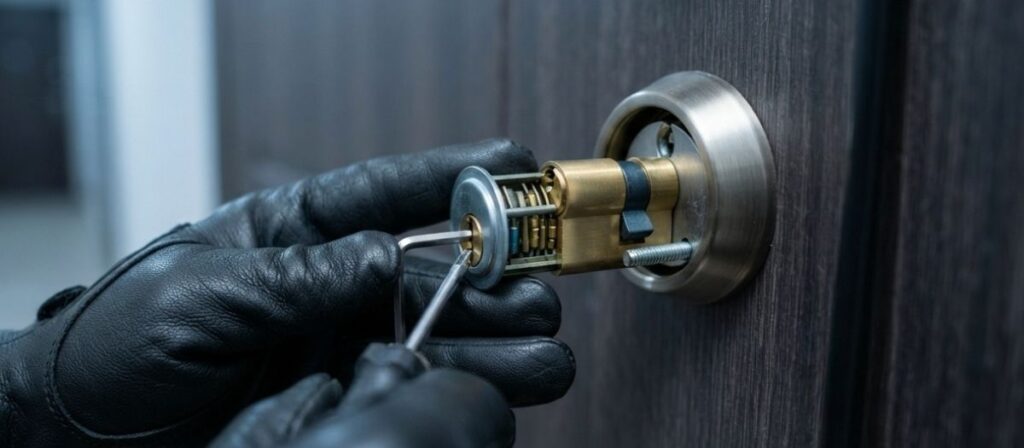
From there, the work itself usually involves either rekeying the existing cylinder, which changes the internal pin configuration so all previous keys stop working while reusing the existing hardware, or full lock replacement if the hardware is damaged, outdated, or the property manager wants an upgrade. Rekeying is generally the faster and more cost-effective option when the existing lock body is in good condition, while replacement makes sense if the cylinder shows wear, damage from the eviction itself, or simply doesn’t meet the security standard a property manager wants going forward. This is the same underlying mechanical process covered in our Rekeying for Commercial Properties After Employee Turnover blog, applied here to a residential vacancy rather than a staff departure.
A thorough locksmith will also confirm whether the unit has any secondary entry points, a back door, a sliding patio door, a garage connection, since a former tenant’s key or code might still work there even after the front door is addressed. If the unit uses a smart lock or electronic keypad, credentials need to be reset or deleted entirely rather than just changing a physical key, since a retained access code is functionally identical to a retained physical key.
Documentation and Why It Matters for Property Managers
This is a detail almost no competitor content addresses clearly, and it’s worth building into standard practice. Ask your locksmith for a dated service record confirming what was done, which unit, which locks, and when. This documentation protects the property manager in the event a dispute arises later, whether that’s a question about when security was restored, a disagreement over unreturned tenant property, or a liability question if an incident occurs after the eviction. A property manager handling multiple units across Champaign County, particularly in dense rental corridors near Campustown, benefits from this kind of record-keeping as a standard part of every eviction-related service call, not an occasional extra.
Mistakes Champaign County Property Managers Make With Eviction Locksmith Services
A handful of avoidable errors show up repeatedly in this specific type of service call.
Requesting a lock change before sheriff enforcement. This is the single most serious mistake, and it’s one a licensed locksmith should catch and decline even if a property manager insists. Acting on a court judgment alone, before the sheriff has physically carried out the eviction, still constitutes a self-help eviction in most circumstances.
Assuming a returned key means no risk. Even when a tenant hands back their key at move-out, there’s no way to confirm a copy wasn’t made during the tenancy. Rekeying every unit after every vacancy, eviction or voluntary move-out alike, closes this gap rather than relying on trust that no duplicate exists.
Overlooking high-turnover rental patterns near UIUC. Properties in the Campustown corridor and near-campus rental housing see frequent occupant changes, sometimes involving subletters or roommates who were never on the original lease and therefore never formally returned a key at all. This makes prompt rekeying after every legitimate vacancy, not just contested evictions, a meaningfully higher priority in this specific rental market than in a more stable residential area.
Not upgrading hardware during an otherwise necessary service call. If a unit’s existing locks are outdated, low-grade, or original to an older building common in parts of Downtown Urbana, an eviction-driven lock change is a natural opportunity to upgrade to better hardware rather than simply re-pinning the same aging cylinder. Lock Security Grades for Commercial Doors blog covers what those grade differences mean for durability and security if you’re considering an upgrade during this process.
Frequently Asked Questions
How much notice does a landlord have to give before evicting a tenant in Illinois?
This depends on the reason for eviction. Nonpayment of rent generally requires a 5-day notice, while a lease violation generally requires a 10-day notice, after which the landlord can file suit in court if the issue isn’t resolved.
Can a tenant be evicted immediately in Illinois?
No. Illinois requires landlords to go through the court process, serving proper notice, filing suit, obtaining a judgment, and having the sheriff carry out the physical eviction. There’s no legal path to immediate removal without court involvement, regardless of the circumstances.
What do eviction locksmiths usually do once they arrive at a property?
After confirming the eviction has been lawfully completed by the sheriff, a locksmith typically rekeys or replaces the unit’s locks, checks secondary entry points, resets any electronic access codes, and provides documentation of the work completed.
Is it cheaper to rekey or fully replace the locks after an eviction?
Rekeying is generally less expensive since it reuses the existing lock hardware and only changes the internal pin configuration. Full replacement becomes necessary if the existing hardware is damaged, outdated, or doesn’t meet the property manager’s current security standards.
Do I need to rekey every unit after a tenant moves out, even without an eviction?
There’s no specific Champaign County ordinance requiring it the way Chicago’s municipal code does for Cook County, but Illinois landlords generally carry liability exposure if a former occupant’s retained key access leads to harm or theft. Rekeying after every vacancy is the more protective standard practice.
How fast can a locksmith come out after a Champaign County sheriff eviction?
Most licensed locksmiths can schedule same-day service once the sheriff’s enforcement is confirmed, since securing the property promptly reduces the property manager’s exposure to unauthorized re-entry or damage.
✅ Key Takeaways
Eviction locksmith services exist to secure a property after a lawful eviction, not to help execute one. The critical fact every Champaign County property manager needs to internalize is timing: locks can only be changed after the sheriff has physically enforced a court-ordered eviction, and acting earlier risks serious liability regardless of how justified the underlying eviction is. Once that point is reached, rekeying or replacing hardware, checking secondary entry points, and documenting the work are the practical steps that protect both the property and the property manager going forward.
If you’re managing a rental property in Urbana or anywhere in Champaign County and need locks addressed after a lawfully completed eviction, call Locksmith Urbana IL at (217) 288-2915. We’ll confirm the eviction status, rekey or upgrade hardware as needed, and provide documentation for your records. Visit our Residential Locksmith Services page to see the full range of property management support we offer.
- Available Right Now
Dealing With a Lockout Right Now?
Locksmith Urbana IL is available 24 hours a day, every day. Same-day service, upfront pricing, and a local technician who knows the Champaign County area.
Most calls in ZIP 61801 & 61802 see a technician on-site within 35 minutes