
- Automotive Lockout Guide
Broken Key Extraction: What Happens When a Key Snaps in the Ignition
- Locksmith Urbana IL
- 8 min read
- Urbana, IL. 61801 / 61802
A key snapping off in the ignition rarely happens at a convenient time. It happens on your way to a shift at Carle Foundation Hospital, in a Campustown parking garage before a UIUC lecture, or in your own driveway on a freezing January morning. What you do in the next five minutes matters more than most drivers realize, because the wrong move turns a simple broken key extraction into a much bigger repair.
This guide walks through why keys break inside ignitions, what to do the moment it happens, how professional extraction actually works, and the one detail almost no other article on this topic explains clearly: what happens to your transponder chip when the key snaps.
Why Keys Snap in the Ignition
A key breaking off isn’t random. It’s almost always the end result of stress that built up over months or years.
Broken key extraction calls we handle usually trace back to one of two root causes: a worn key or a worn ignition cylinder. A key that’s been copied from a copy, carried loose in a pocket, or bent slightly from sitting on a keyring with a heavy fob eventually develops micro-fractures near the shoulder or first cut. Turn it with enough torque, and it gives out.
The ignition cylinder itself can be the real culprit. When internal tumblers wear down or gather dirt and debris, the key needs more force to turn. Drivers adapt without noticing, applying a bit more pressure every week, until the key snaps under a stress the cylinder was creating, not the key.
Gear position causes a lot of stuck-key incidents too. If the transmission isn’t fully seated in Park, many ignition systems physically resist turning the key at all. Forcing it in that state is one of the more common ways a key snaps clean off.
Central Illinois winters add a factor competitors rarely mention. Metal contracts and becomes more brittle in cold temperatures, and a key that already has a hairline crack from wear is far more likely to fail during a hard start on a sub-zero morning than in July. If your ignition has felt stiff all fall and winter is approaching, that’s the window to address it, not push through it.
Manufacturers occasionally issue a technical service bulletin (TSB) for ignition cylinders on specific model years, usually addressing a known tumbler wear pattern. If your key has snapped more than once on the same vehicle, it’s worth asking your locksmith or dealer whether a bulletin exists for your make and model.
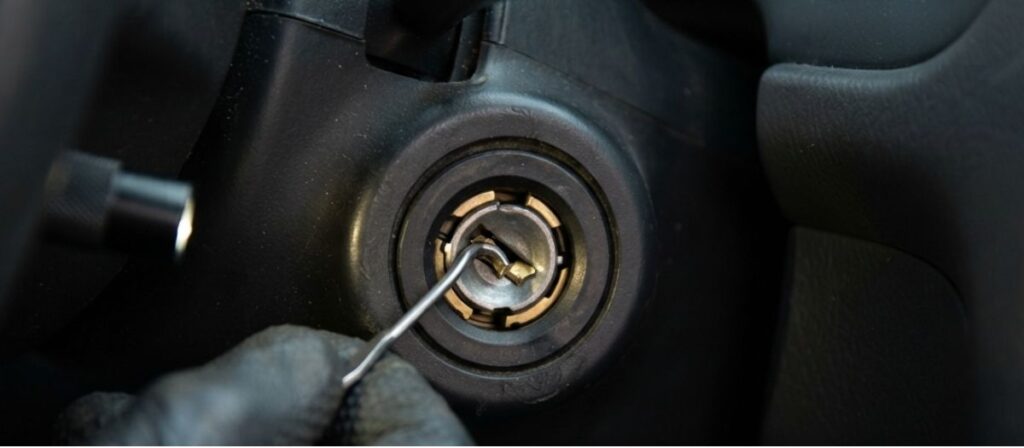
What to Do the Moment Your Key Snaps
Stop turning the key immediately. Continued pressure is the single most common reason a simple job turns into a complicated one, because it can drive the fragment deeper or chip the ignition wafers.
Leave the car in Park and shut off the engine if it’s still running, following your vehicle’s normal shutdown steps. Don’t try to restart it, and don’t attempt to jiggle the fragment loose with the engine on.
Look at how much of the key is visible. If a decent piece is protruding and moves freely when you nudge it gently with your fingers, you may be able to remove it without tools. If it’s flush with the ignition face or buried inside, resist the urge to dig for it.
If the vehicle won’t shift or start because of the broken piece, plan on the car being undrivable until extraction is complete. This is where towing sometimes becomes part of the conversation, though a mobile locksmith can often eliminate that need entirely by coming to you.
Why DIY Tools Almost Always Make It Worse
Nearly every driver’s first instinct is to reach for whatever’s in the glove box: tweezers, a paperclip, a small screwdriver, sometimes even superglue on a toothpick or a hacksaw blade to try to grip the fragment. In practice, most locksmiths will tell you these attempts cause more damage than the original break.
Ignition cylinders hold a stack of precision wafers with tolerances measured in thousandths of an inch. A metal tool jabbed in at the wrong angle can scratch the keyway, bend a wafer, or shove the fragment past the point any standard extraction tool can reach. At that point, a ten-minute job becomes a full cylinder replacement.
There’s also a security risk competitors rarely bring up. Aggressive manipulation of the ignition, especially with the wrong tool, can trigger the vehicle’s anti-theft or security system, locking out the ignition electronically even after the fragment is removed. On vehicles still under warranty, DIY tampering with the ignition can also raise questions about warranty voiding if a dealer later inspects the damage.
If you have access to a light penetrating oil or dry lubricant, a small amount applied around the keyway opening can sometimes help a partially exposed fragment slide free without added force. This is different from jamming a tool inside, and it’s one of the few DIY-friendly steps that rarely backfires.
How Professional Broken Key Extraction Actually Works
A trained technician doesn’t start pulling. The first step is fragment position and depth assessment, using a small inspection light or probe to see how far the piece has traveled and whether it’s caught on a wafer.
From there, the locksmith selects a broken key extractor tool, a thin, hook-shaped pick sized to the specific keyway profile. The hook is worked in alongside the fragment, not against it, and used to draw the piece straight out along the same path the key originally traveled.
For fragments lodged deep inside an automotive ignition, especially on vehicles where the barrel sits behind the steering column shroud, the technician may need to partially disassemble the column to access the cylinder directly. This is a more involved job than a straightforward extraction and typically takes longer, often 30 to 45 minutes depending on the make and model.
Once the fragment is out, a competent technician doesn’t stop there. Post-extraction ignition cylinder inspection is the step most drivers never think to ask about, and it’s the difference between a job that’s actually finished and one that leaves a hidden problem behind.
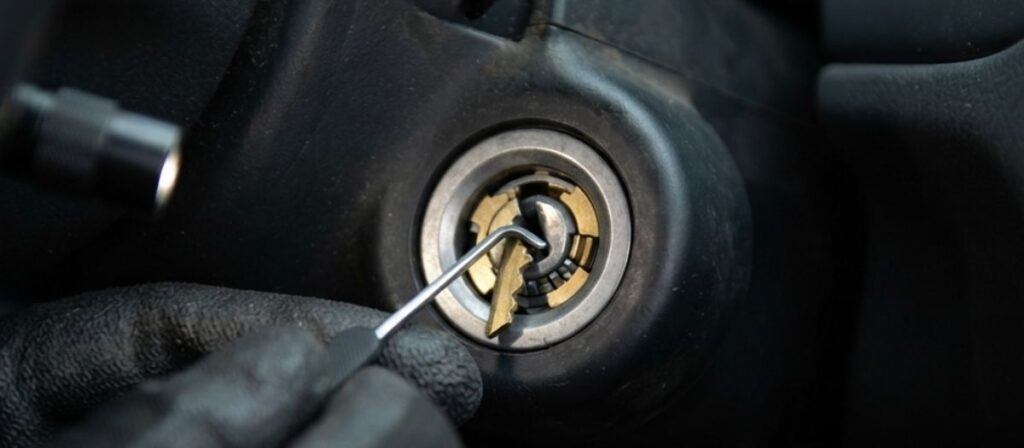
The Transponder Chip Problem No One Else Explains
Here’s the detail: almost every guide on this topic skips entirely, and it matters more than most drivers expect.
Modern car keys aren’t just cut metal. Most contain a transponder chip embedded in the plastic head that communicates with your vehicle’s immobilizer system. If your key snapped and the chip stayed with the head in your hand rather than breaking off with the blade, that’s good news. But if the break happened close to the head, or the chip itself was damaged in the snap, extraction alone won’t get you driving again.
Removing the broken metal fragment solves the mechanical problem. It does not restore the electronic handshake between a working key and your car’s computer. In that scenario, you’re looking at a two-step process: extraction first, then cutting and programming a new transponder key before the vehicle will start.
This is worth knowing before you assume a locksmith visit ends the moment the fragment comes out. Ask upfront whether your key had a chip, and if you’re not sure, bring your spare key (if you have one) so the technician can check. For more background on how these chips work, see our “What Is a Transponder Key” page.
What Most Broken Key Extraction Guides Don't Tell You
A few things get glossed over or skipped entirely across most articles on this topic, including the strongest competitors.
Your spare key isn’t automatically safe to use. If the original key snapped because the ignition cylinder itself is worn or binding, a spare cut from the same original code will eventually do the same thing. Before you trust a spare key in that ignition, have the cylinder inspected first.
A single broken key doesn’t always mean a bad key. Sometimes the fragment tells the real story. Bent metal, heavy wear near the cut, or corrosion on the broken piece points to the key as the failure. A clean break with no visible wear on an otherwise newer key points more toward the cylinder.
Rekeying deserves consideration, not just a mention. If you’ve ever lost a key, sold the vehicle recently, or aren’t sure who else might have a copy, a broken key extraction visit is a natural point to also rekey or reprogram the ignition so old keys no longer work. Most guides bring this up as an afterthought. It’s worth a real decision, not a footnote.
Illinois locksmith licensing matters more than drivers assume. Under 225 ILCS 447, locksmiths performing ignition and lock work in Illinois are required to hold state licensing. Ignition work specifically involves disassembly near steering and security components, so verifying licensing before letting someone work on your vehicle isn’t just a formality, it protects you if something goes wrong.
Will You Need Ignition Repair or Full Replacement?
Not always. In many broken key extraction calls, the key was the only thing that failed and the cylinder tests fine afterward.
Ignition cylinder replacement becomes the right call when the cylinder was already worn before the break, when internal wafers were damaged during the snap or during a DIY attempt, or when the key broke specifically because the barrel was binding. In those cases, a new key alone won’t prevent a repeat failure.
Ignition cylinder replacement vs. repair comes down to the extent of the damage. A cylinder with light wear and no broken internals can often be repaired or rekeyed for a lower cost. A cylinder with a cracked plug or bent components generally needs full replacement.
For Champaign County drivers, extraction on an accessible fragment typically runs in a modest range, while jobs requiring column disassembly or a full cylinder swap cost more due to added labor and parts. A locksmith should always give you a clear quote before starting work, not after.
Preventing the Next Broken Key
A few habits go a long way toward avoiding a repeat trip.
- Replace a key showing visible bends, cracks near the head, or rounded cuts before it fails on you
- Lighten your keyring, since heavy fobs and extra keys add constant stress to the ignition
- Have a stiff or hard-turning ignition inspected before the resistance causes a break
- Keep a verified spare key on hand, checked for the same wear signs as the original
- Avoid duplicating keys from a copy, since bitting tolerance drifts slightly each generation
If you’re a UIUC-area renter dealing with an older ignition in a used or hand-me-down vehicle, or you park along the Philo Road corridor in weather that swings from summer heat to winter cold, these small maintenance checks matter more than they would in a milder climate.
Frequently Asked Questions
What should I do if my key snaps in the ignition?
Stop turning it immediately, shut the vehicle off if it’s running, and avoid inserting any tool into the keyway. Leave the fragment where it is and call a locksmith who specializes in broken key extraction rather than attempting removal yourself.
Can a magnet pull a broken key out of the ignition?
No. Most vehicle keys are made from brass, nickel silver, or non-magnetic steel alloys, so a magnet won’t grip the fragment. This is a common myth, and attempting it usually wastes time while the fragment stays lodged in place.
How much does broken key extraction cost in Urbana IL?
Pricing depends on how deep the fragment sits and whether the ignition column needs partial disassembly. A straightforward extraction costs less than a job requiring cylinder removal, and a locksmith should quote the price before starting work.
Will I need a new ignition after the key is removed?
Not necessarily. Many keys fail while the cylinder is still in good condition. Replacement or repair only becomes necessary if the cylinder was already worn, binding, or damaged during the break.
Can a snapped key be repaired, or does it need full replacement?
A snapped key itself cannot be rejoined or repaired. Once removed, the broken key needs to be replaced with a newly cut key, and if it had a transponder chip, that new key also needs to be programmed to the vehicle.
What happens if the broken key had a transponder chip?
If the chip stayed intact in the head you’re holding, extraction alone may get you driving again once a new blade is cut. If the chip broke or was damaged, you’ll need a new key cut and programmed before the vehicle starts, even after the fragment is removed.
How do I start a car with a key stuck and broken in the ignition?
You shouldn’t try. Forcing the ignition with a partial fragment still inside risks pushing it deeper or damaging the wafer stack. Wait for a locksmith to extract the fragment cleanly before attempting to start the vehicle again.
✅ Key Takeaways
A broken key in the ignition is almost always the result of gradual wear, not bad luck, and forcing the fragment out yourself is the most common way to turn a small problem into an expensive one. Professional broken key extraction protects the ignition cylinder while removing the fragment, and a proper visit should also include checking whether the cylinder itself needs attention and whether your key’s transponder chip survived the break.
If your key has snapped in Urbana, Champaign, or anywhere in Champaign County, the safest next step is to leave the vehicle where it is and call a licensed technician who can assess the fragment on-site. Reach Locksmith Urbana IL at (217) 288-2915, or visit our Automotive Locksmith Services page to see how we handle extraction, rekeying, and replacement key programming in a single visit.
- Available Right Now
Dealing With a Lockout Right Now?
Locksmith Urbana IL is available 24 hours a day, every day. Same-day service, upfront pricing, and a local technician who knows the Champaign County area.
Most calls in ZIP 61801 & 61802 see a technician on-site within 35 minutes