
- Automotive Lockout Guide
What Is a Transponder Key and Why Can't a Hardware Store Duplicate It
- Locksmith Urbana IL
- 8 min read
- Urbana, IL. 61801 / 61802
Somebody in nearly every Urbana neighborhood has had this exact moment: a fresh key copy from a hardware store kiosk, cut perfectly, sliding smoothly into the ignition, turning without resistance, and the car simply refusing to start. No error message, no drama, just nothing. The cut was flawless. The car still doesn’t care.
What is a transponder key, and why does a perfectly cut copy fail this way? The short answer is that a transponder key isn’t just a shaped piece of metal, it’s a small electronic device your car has to recognize before it will let the engine run. This guide explains exactly what that means, why a hardware store’s equipment was never built to solve it, and how to tell whether your own vehicle even has this problem in the first place.
What Is a Transponder Key, Really
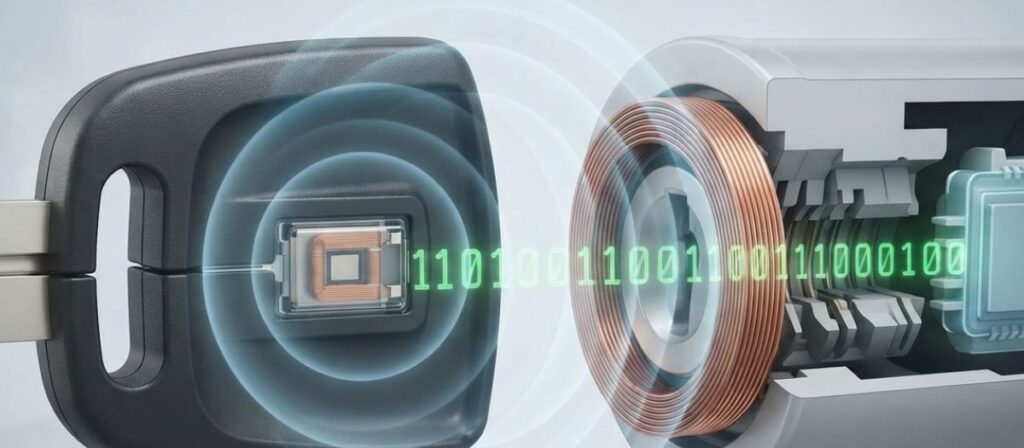
A transponder key looks like an ordinary car key from the outside, usually with a noticeably thick plastic head. Inside that head sits a tiny microchip, sealed in and invisible from the outside, that communicates with your vehicle before it will allow the engine to start.
Here’s the actual mechanism, which most guides gloss over: the chip has no battery of its own. A small antenna ring built into your ignition cylinder, or near the start button on newer vehicles, briefly powers the chip through electromagnetic induction the instant you insert or present the key, the same basic principle as wireless phone charging. Once powered, the chip transmits a unique digital code back to the car. Your vehicle’s onboard computer checks that code against what it has stored in memory. If the two match, the engine is allowed to start. If they don’t, or if no signal arrives at all, the fuel system or ignition circuit stays locked, regardless of whether the metal key itself turns freely.
That last part is the whole answer to why a cut-only copy fails. The metal shape only handles the mechanical side, turning the tumblers or the ignition cylinder. Starting the engine is a separate, entirely electronic conversation between the chip and the car, and a shape alone never enters that conversation.
Why a Hardware Store Physically Cannot Duplicate It
This is the part almost no competitor content actually explains at the mechanical level, and it’s worth being direct about it. A hardware store’s key-cutting kiosk or in-store machine is built to do exactly one job: trace the cut pattern of an existing metal key and reproduce that same pattern on a blank. It reads the shape. That’s the entire function of the machine.
It has no chip reader, no way to detect what code, if any, lives inside your key head, and absolutely no way to talk to your vehicle’s onboard computer to register a new code. Even if the blank they cut has a slot for a chip, and even if they happen to insert a generic chip into it, an unprogrammed chip transmits nothing your car recognizes. The result is a key that turns the ignition cylinder mechanically and accomplishes nothing else.
This is the exact misconception that trips people up, and it deserves saying plainly: duplicating a transponder key is not the same task as duplicating a house key, just a harder version of it. It’s two separate, unrelated processes stacked on top of each other, cutting the metal shape and programming the electronic code, and a hardware store is only ever equipped to do the first one.
How a Locksmith Actually Programs a New Transponder Key
Programming is the step a hardware kiosk skips entirely, and it’s where the real work of a transponder key replacement happens. A locksmith uses dedicated programming equipment that connects either directly to the key or through your vehicle’s OBD port, reads or writes the manufacturer-specific code your car’s immobilizer expects, and registers the new key as authorized in the car’s memory.
This process, sometimes called immobilizer reset or key registration depending on the vehicle, tells the car explicitly that this new chip is now a valid key. Only after that registration step will the car respond to the chip’s signal the way it does to your original.
Not every transponder chip works the same way underneath, which is part of why this isn’t a one-size-fits-all process. Some vehicles use a fixed code that never changes. Others use a rolling code, where the expected signal changes after every ignition cycle, following a synchronized pattern only the car and a correctly programmed key know. Rolling code systems are harder to intercept or clone, which is exactly the point, but it also means the programming equipment has to match the specific protocol your vehicle uses, not a generic one-size version.
Common Misconceptions About Transponder Key Duplication
A few beliefs cause more confusion, and more wasted trips, than anything else on this topic.
“If the key turns, it should start the car.” This is the single most common assumption, and it’s wrong for the exact reason covered above. A mechanically correct cut with no programmed chip, or a chip programmed for the wrong vehicle, will turn the ignition and go nowhere.
“All transponder keys are basically the same, just different shapes.” Not even close. Two chips can look physically identical, same casing, same size, and use completely different encryption. A locksmith can’t reliably identify which chip your key uses just by looking at it. The only accurate way to identify a chip is with a dedicated chip reader, a tool that briefly powers the chip and reports back exactly what type it is.
“My car is too old to have this problem.” This one actually cuts the other way from what most people assume, and it’s genuinely useful information for Urbana specifically. Transponder keys became standard across most vehicles roughly from the late 1990s through the early-to-mid 2000s, with adoption timing varying meaningfully by brand and even by model year within the same brand. If you’re driving an older used vehicle, common among UIUC students and Campustown renters working with a tighter budget, there’s a real chance your car predates transponder technology entirely and uses a simple mechanical key that a hardware store genuinely can duplicate without issue. Checking your vehicle’s actual key type before assuming you need a locksmith saves an unnecessary call.
How to Tell If Your Key Is a Transponder Key
A few quick checks answer this without needing to guess.
Look at the key head itself. A noticeably thick plastic head, compared to a slim traditional metal key, is often a visual clue, though not a guaranteed one on its own since not every chip design bulks up the head the same way.
Watch your dashboard when you turn the ignition to the “on” position without starting the engine. Many vehicles briefly flash a security-related icon or light, sometimes shaped like a key, a padlock, or simply the word “security.” This flash is the car confirming its immobilizer system is active, a strong sign your vehicle relies on transponder verification.
If neither check gives you a clear answer, a locksmith can confirm it in under a minute using your vehicle’s VIN or by directly reading the key with a chip reader, without any guesswork on your end.
What Most Transponder Key Guides Don't Tell You
A few things get consistently skipped or underexplained even in the more detailed competitor content available on this exact topic.
Most guides treat the chip casing material as a footnote, if they mention it at all. Transponder chips come housed in either glass or ceramic. Glass chips are more fragile and tend to show up in older vehicles or simpler immobilizer systems, while ceramic chips are more durable and standard in newer builds. This matters practically, since dropping an older glass-chip key on a hard surface, a driveway, a parking garage floor near Campustown, carries a real risk of cracking the chip internally with no visible outward damage, leaving you with a key that looks fine but silently stops working.
Almost no guide connects vehicle age to Central Illinois driving patterns specifically. A used vehicle bought for a UIUC student’s four years on campus, or a hand-me-down car within a Champaign County family, may be old enough to predate transponder requirements entirely, or old enough to use a first-generation glass chip system that behaves differently from what’s standard on a car built in the last decade. Knowing which category your specific vehicle falls into changes both the cost and the process before you ever call anyone.
Finally, verification gets treated as an afterthought in most competitor content, when it should be treated as a basic trust signal. A legitimate locksmith should ask for proof of ownership, an ID matching your registration, before programming any key to your vehicle, regardless of whether you’re standing there with your original key or have lost every key you own. Illinois locksmiths operate under licensing requirements set out in 225 ILCS 447, and that verification step exists specifically because a transponder key is functional access to your vehicle, not just a piece of cut metal.
Frequently Asked Questions
What is the actual purpose of a transponder key beyond just opening the door?
Its main job is starting the engine securely. The chip proves to your car’s immobilizer system that this is an authorized key, which prevents the vehicle from being hot-wired or started with a duplicated but unprogrammed key.
Can you replace a transponder key without having the original?
Yes. A locksmith can program a new transponder key using your vehicle’s VIN even with zero working keys remaining, though this generally takes longer and costs more than duplicating from an existing working key.
What's actually different between a transponder key and a regular metal key?
A regular metal key relies entirely on its cut shape to turn a mechanical lock. A transponder key adds an embedded chip that must also transmit the correct electronic code before your vehicle’s computer will allow the engine to start.
Can a transponder key lose its programming over time?
Yes, though it’s uncommon. Physical damage to the chip, such as a crack from being dropped, or in rare cases a vehicle software update, can cause a previously working transponder key to stop being recognized.
What's the difference between a key fob and a transponder key?
A transponder key specifically refers to the chip that authorizes engine start. A key fob often refers to the remote buttons for locking, unlocking, or opening a trunk. Many modern keys combine both functions into one unit, but they’re technically separate systems that can sometimes fail independently of each other.
How expensive are transponder keys compared to a regular hardware store copy?
Cost depends on your specific vehicle and chip type, since the programming equipment and process vary by manufacturer. A regular mechanical key copy at a hardware store costs very little, but that copy will not start your vehicle if your car uses a transponder system. A locksmith can quote an exact price once they know your vehicle’s make, model, and key type.
How does a transponder chip work without a battery?
It’s powered briefly by the antenna ring in your ignition or near your start button, which generates a small electromagnetic field the instant you insert or present the key. That’s enough to wake the passive chip long enough to transmit its code, similar to how wireless phone charging works.
✅ Key Takeaways
A transponder key is really two systems in one, a mechanically cut shape and a separately programmed electronic code, and a hardware store’s key-cutting equipment can only ever handle the first half. That’s the entire, concrete reason a fresh copy can turn perfectly and still leave your car dead. Checking your vehicle’s actual key type before assuming you need specialized programming, especially with an older used vehicle common around Urbana and UIUC, can save you an unnecessary trip.
If you’re not sure whether your car uses a transponder system, or you need a working replacement programmed correctly the first time, that’s a quick call rather than a guessing game. Call (217) 288-2915 or visit our automotive locksmith services page to get a straight answer on your specific vehicle.
- Available Right Now
Dealing With a Lockout Right Now?
Locksmith Urbana IL is available 24 hours a day, every day. Same-day service, upfront pricing, and a local technician who knows the Champaign County area.
Most calls in ZIP 61801 & 61802 see a technician on-site within 35 minutes