
- Residential Lockout Guide
What Is a Lock Security Grade and Why Does It Matter for Your Home
- Locksmith Urbana IL
- 8 min read
- Urbana, IL. 61801 / 61802
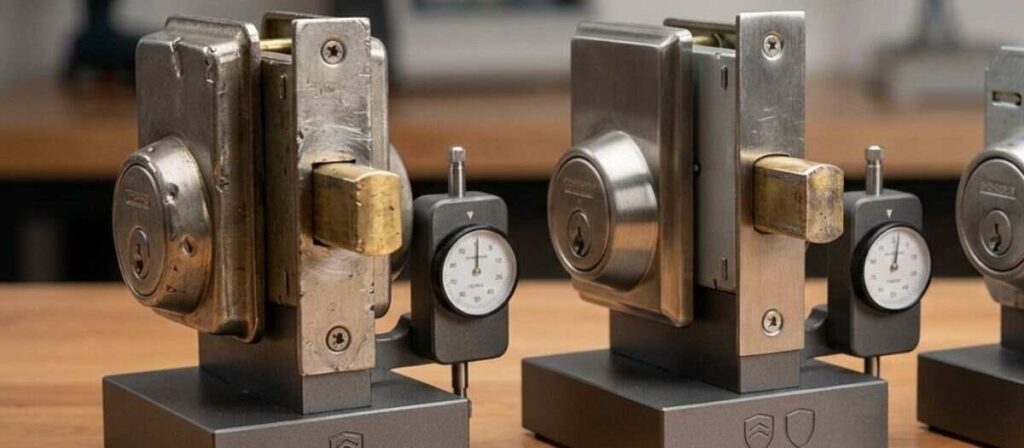
The lock on your front door has a grade stamped somewhere on it. Most homeowners have never looked for it, and most articles about lock security grades never explain what the number actually represents in physical terms.
A lock security grade is not a marketing label. It is a certification that a specific lock passed a set of standardized tests measuring how many times it can be operated before failing, how much impact force it withstands, and how much bolt strength it provides against forced entry. The grade is the output of those tests, not an estimate or opinion.
This article explains what ANSI and BHMA grades actually measure, what the test numbers mean in real-world terms, and which grade matters for which door in a Champaign County home.
Where Lock Security Grades Come From
Two organizations are responsible for the grading system used in the United States: ANSI (American National Standards Institute) and BHMA (Builders Hardware Manufacturers Association).
ANSI does not test locks directly. It is a nonprofit standards oversight body that accredits testing procedures developed by industry groups. BHMA is the organization that actually writes the door hardware testing standards ANSI adopts. When you see a lock labeled “ANSI Grade 1,” that means the lock was submitted to a BHMA-approved testing laboratory, tested against BHMA’s written standard, and met the performance threshold for Grade 1 in every required category.
The most relevant ANSI/BHMA standards for residential locks are:
ANSI/BHMA A156.2 covers bored and preassembled locks (the cylindrical locksets most homes use) ANSI/BHMA A156.40 covers residential deadbolts specifically ANSI/BHMA A156.13 covers mortise locks
These standards define three grade levels. Grade 1 is the highest, Grade 2 is mid-range, and Grade 3 is the entry-level minimum. A lock without an ANSI grade has not been submitted for testing at all, which places it below Grade 3 in terms of verified performance.
What the Tests Actually Measure
Every competitor article on this topic lists the cycle counts for each grade. None of them explain what those numbers mean in practice, or mention the tests that matter most for real-world security.
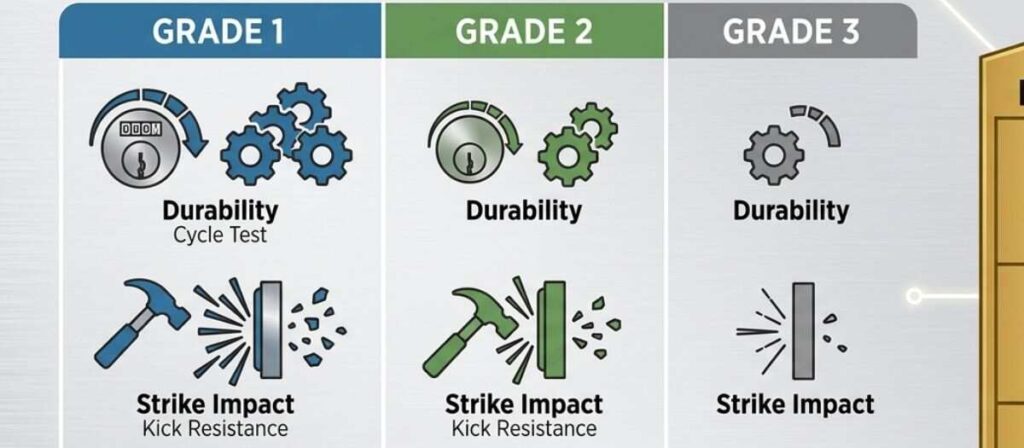
The Cycle Test (Durability)
The cycle test measures how many complete lock/unlock operations a lock can perform before failing. One cycle equals one complete operation.
- Grade 1: 250,000 cycles minimum (deadbolts per A156.40)
- Grade 2: 150,000 cycles
- Grade 3: 80,000 cycles
If you lock and unlock your front door four times per day, 250,000 cycles is roughly 170 years of operation. Grade 3 at 80,000 cycles is roughly 54 years. In that sense, all three grades appear durable for residential use. Cycle count alone is not where the grades diverge most significantly.
The Strike Impact Test (Kick Resistance)
The strike impact test simulates a person attempting to kick through the door. A weighted hammer strikes the lock face repeatedly to test whether the lock and strike plate hold.
- Grade 1: 10 strikes at 75 lbs
- Grade 2: 5 strikes at 75 lbs
- Grade 3: 2 strikes at 75 lbs
This is the test that most directly corresponds to how residential break-ins actually occur. The FBI’s crime data consistently shows that forced entry through doors is the most common method of residential burglary. A Grade 3 lock that fails on the third strike is a different security proposition than a Grade 1 lock that holds through ten.
The Bolt Strength Test (Forced Entry Resistance)
This is the test no competitor article mentions, and it is arguably the most important number on the page.
Under ANSI/BHMA A156.40 for residential deadbolts, a Grade 1 deadbolt bolt must withstand 1,350 pounds of force applied directly to the bolt in an axial direction. This test simulates prying force applied to force the bolt back into the lock body.
- Grade 1: 1,350 lbs axial load
- Grade 2: 900 lbs axial load
- Grade 3: 600 lbs axial load
The difference between Grade 1 and Grade 3 bolt strength is 750 pounds of resistance. That difference is not theoretical. A determined forced entry attempt on a Grade 3 deadbolt with a standard builder strike plate encounters less than half the resistance of a Grade 1 lock, and the strike plate is typically the first thing to fail anyway, not the bolt itself.
ANSI vs BHMA: The Two Grading Systems Explained
This is the source of the most widespread confusion in consumer lock buying, and none of the three competitor articles address it at all.
ANSI grades (1, 2, 3) apply to both residential and commercial hardware. They cover the full range of lock types and are the most commonly referenced grades in product listings and locksmith recommendations.
BHMA Secure Home™ grades (AAA, AA, A, BBB, etc.) are a separate, parallel grading system introduced in 2014 specifically for residential hardware. They grade three categories independently: Security, Durability, and Finish. Each category receives an A, B, or C rating. A lock rated AAA has earned the top mark in all three categories.
The two systems are not directly convertible. Critically: an ANSI Grade 2 lock can carry a BHMA “A” security mark because the BHMA security tests and the ANSI Grade 2 security tests are not identical. This has caused real consumer confusion when comparing products across brands.
BHMA certification is also strictly voluntary and costs the manufacturer money. A lock that has not been submitted for BHMA certification is not necessarily worse than one that has. It simply has not been tested under that program. A lock with no BHMA label may still carry a valid ANSI grade from ANSI-referenced testing.
For practical decision-making: use the ANSI grade as your primary reference, and treat BHMA certification as an additional quality signal when it is present.
What Grade Does Each Door in Your Urbana Home Actually Need
The correct grade depends on the door’s role in your home’s security, not a single standard applied to every door. This is the section Keyman Lock comes closest to covering, but without the local context that makes it actionable for Champaign County homeowners.
Primary exterior doors (front door, rear door, door from attached garage to living space) should carry Grade 1 hardware. These are the highest-traffic entry points and the most likely targets for forced entry. In Urbana’s rental market near UIUC, where properties experience higher occupant turnover and more foot traffic than owner-occupied homes, Grade 1 on primary entries is the correct specification.
Secondary exterior doors (side entrance, basement access door, patio door deadbolt) can use Grade 2 without a meaningful security compromise. Grade 2 withstands five kick impacts at 75 pounds and 900 pounds of axial bolt force, adequate for doors that are less trafficked and less likely to be the primary forced entry target.
Interior doors (bedroom, bathroom, home office with a lockset) are appropriately served by Grade 3 hardware. These doors exist for privacy, not security. A Grade 3 lock on an interior door is the correct specification, not a security failure.
The practical cost implication: upgrading from Grade 3 to Grade 1 on a single exterior door costs $85 to $150 installed in ZIP codes 61801 and 61802. Upgrading three exterior doors (front, rear, and garage access) runs $250 to $450 total with a licensed locksmith. That investment is not repeatable if a break-in occurs.
The Weakest Door Problem: Why Mismatched Grades Across Your Home Matter
This principle appears in The Lockwizard article as the most important insight in the three competitor pages, and it is completely absent from every US locksmith article on this topic.
A burglar does not attempt your strongest door. They attempt your weakest one.
If your front door has a Grade 1 deadbolt and your rear door has builder-grade Grade 3 hardware, the Grade 1 front door is effectively irrelevant. A forced entry through the rear door in approximately two to three kick impacts renders the front door’s security value zero.
In Urbana IL homes, particularly older properties near Crystal Lake Park and the Downtown corridor, it is common to find hardware that was replaced piecemeal over decades. A homeowner may have upgraded the front door lock after moving in but left the original builder hardware on the rear and garage access doors untouched. A licensed locksmith doing a full property assessment, not just responding to a specific repair, can identify this pattern before it becomes a problem.
The practical recommendation is to standardize lock grades across all exterior entries in a single service visit rather than upgrading one door at a time. Rekeying all locks to the same key at the same time eliminates both the security gap and the ongoing inconvenience of carrying multiple keys.
Why Most New Homes Ship With Grade 3 Locks
This is the section Door N Key covers briefly but without the specifics that make it actionable.
Builder-grade hardware is Grade 3 by design. Residential developers choose hardware that meets minimum building code requirements at the lowest cost. Most US building codes reference ANSI standards but require only that locks meet a minimum functional standard. They do not mandate Grade 1 or Grade 2 on exterior doors.
If your Urbana IL home was built in the last twenty years, or if you have moved into a rental unit that has not had its hardware upgraded, there is a meaningful probability that your exterior door locks are Grade 3. The locks work. They cycle, they latch, they lock. They are simply not rated to withstand the same forced entry force as Grade 1 or Grade 2 hardware.
How to check: look on the edge of the lock body or on the strike plate for a stamped number or code. The grade is sometimes printed on the original packaging if you still have it. The manufacturer’s model number, typically printed on the interior plate of the lock, can be cross-referenced on the manufacturer’s website to find the ANSI grade. If none of these methods yields a clear answer, a licensed locksmith can identify the grade in under five minutes during a service visit.
Lock Security Grade and Your Homeowner's Insurance
This is a section that does not appear in any of the three competitor articles and is directly referenced in ANSI/BHMA compliance literature.
Illinois homeowners’ insurance policies assess break-in claims based in part on the hardware installed at the point of entry. Some policies include language that can result in partial or full claim denial if the lock at the breached entry point is found to be inadequate, particularly if the breach involved minimal force consistent with low-grade hardware.
Installing ANSI/BHMA Grade 1 certified deadbolts, or hardware carrying the BHMA Secure Home™ certification, may qualify you for a reduced premium rate with some Illinois insurers. This is not guaranteed, and the specific terms depend on your policy carrier and policy language. The correct step is to confirm with your insurer what hardware specifications they recognize before purchasing locks, not after.
What Most Lock Security Grade Blogs Don't Tell You
The BHMA Certification Is Randomly Re-Tested After Award
Once a manufacturer receives BHMA Secure Home™ certification, BHMA periodically pulls a random production unit from store shelves and re-tests it against the same standards used for initial certification. If the production unit fails, the certification is revoked.
This random re-testing program means BHMA certification is not simply a one-time evaluation. It is an ongoing quality assurance mechanism. For consumers, it means a lock currently carrying the BHMA Certified® mark has had its in-production quality verified more recently than its initial certification date suggests.
A Lock Without Any Grade Is Below Grade 3
An ungraded lock, one with no ANSI rating and no BHMA certification, has not been submitted for testing at all. It may perform well. It may not. There is no third-party verification of its cycle count, strike impact resistance, or bolt strength. For exterior doors, any ungraded lock represents an unknown and unverifiable security level. Grade 3, the lowest rated classification, still represents verified minimum performance. An ungraded lock does not.
Grade Applies to the Lock, Not the Installation
A Grade 1 deadbolt installed with a standard builder strike plate secured by 3/4-inch screws into door casing does not perform as a Grade 1 security system. The ANSI tests evaluate the lock in isolation under controlled laboratory conditions. The strike plate, the door frame, the door thickness, and the installation quality all affect real-world forced entry resistance independently of the lock’s grade. A licensed locksmith installing a Grade 1 lock correctly will confirm strike plate security and frame condition as part of the job.
Frequently Asked Questions
What is a lock security grade?
A lock security grade is a certification assigned by ANSI (American National Standards Institute) and BHMA (Builders Hardware Manufacturers Association) after a lock passes standardized laboratory tests measuring cycle durability, strike impact resistance, and bolt strength. Grade 1 is the highest, Grade 2 is mid-range, and Grade 3 is the minimum tested standard.
What does ANSI Grade 1 mean on a lock?
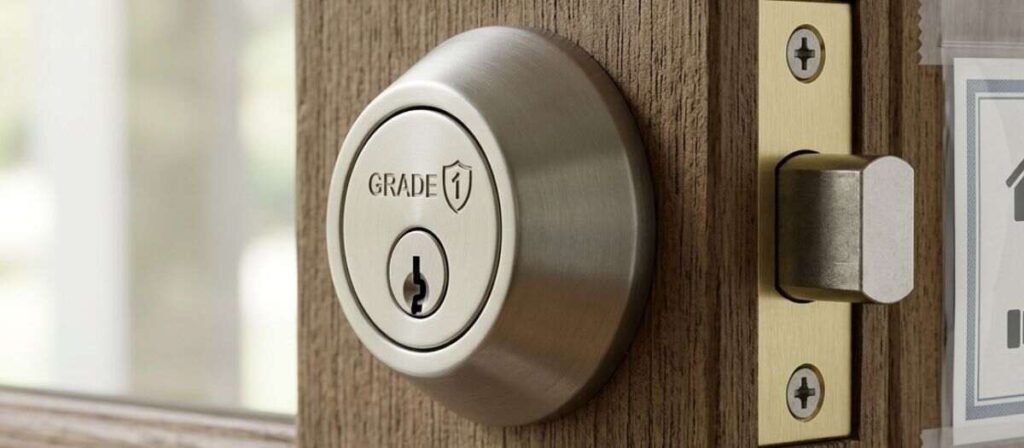
An ANSI Grade 1 lock has passed the most rigorous BHMA testing requirements: a minimum of 250,000 operation cycles, 10 strike impacts at 75 pounds, and a bolt that withstands 1,350 pounds of axial force. It is the appropriate grade for all primary exterior doors in residential and commercial applications.
What is the difference between ANSI and BHMA lock grades?
ANSI grades (1, 2, 3) apply to both residential and commercial hardware and are the most widely referenced grading system. BHMA Secure Home™ grades (using letters A, B, C in three categories) are a separate system created in 2014 specifically for residential hardware. The two systems are not directly convertible. An ANSI Grade 2 lock can carry a BHMA “A” security mark because the tests differ. Use ANSI grade as your primary reference.
What lock grade do I need for my front door in Urbana IL?
Grade 1 is for all primary exterior doors (front, rear, and garage-to-living-space entry). Grade 2 is acceptable for secondary exterior entries. Grade 3 should be limited to interior doors where security is not the primary concern. In Urbana’s rental housing market near UIUC, Grade 1 on all exterior entries is the correct baseline.
Do lock grades matter for insurance in Illinois?
They can. Some Illinois homeowners’ insurance policies reference hardware standards in their terms and may partially or fully deny claims for break-ins at entry points with inadequate hardware. Installing ANSI Grade 1 certified hardware or BHMA Secure Home™ certified locks may also qualify for reduced premiums with some carriers. Confirm your policy specifics before purchasing hardware.
How do I find out what grade my current locks are?
Check for a stamped number on the lock body edge, strike plate, or interior plate. Look up the model number (usually printed inside the lock) on the manufacturer’s website. If you cannot determine the grade, a licensed locksmith can identify it in under five minutes during a service visit. If your home is less than twenty years old, there is a meaningful probability your exterior locks are builder-grade Grade 3.
Is a Grade 3 lock safe for an exterior door?
Grade 3 locks meet verified minimum performance standards, but they withstand only two strike impacts at 75 pounds and 600 pounds of axial bolt force, significantly less than Grade 1 or Grade 2 hardware. Security professionals and licensed locksmiths do not recommend Grade 3 locks for primary exterior doors because the difference in forced entry resistance compared to Grade 1 is substantial and the cost to upgrade is relatively modest.
Three Things to Remember
First, lock security grades are the output of real laboratory tests with specific numbers. A Grade 1 deadbolt bolt withstands 1,350 pounds of force. A Grade 3 bolt withstands 600 pounds. That gap is the actual security difference between the grades, not a marketing claim.
Second, mismatched grades across your exterior doors give a burglar a specific target. The weakest door is always the entry point. Standardizing grades across all exterior entries in a single service visit eliminates this vulnerability more effectively than upgrading one door at a time.
Third, if you do not know what grade your current exterior locks are, find out before assuming they are adequate. Builder-grade Grade 3 hardware on new construction and hardware replaced piecemeal over decades in older Urbana properties are both common scenarios where homeowners are living with unverified or inadequate security without knowing it.
If you want a lock grade assessment on your Urbana IL property, call Locksmith Urbana IL at (217) 288-2915. A licensed technician will identify the grade on every exterior entry, flag any mismatched hardware, and give you a specific upgrade recommendation and price before any work begins.
- Available Right Now
Dealing With a Lockout Right Now?
Locksmith Urbana IL is available 24 hours a day, every day. Same-day service, upfront pricing, and a local technician who knows the Champaign County area.
Most calls in ZIP 61801 & 61802 see a technician on-site within 35 minutes