
- Automotive Lockout Guide
How a Locksmith Opens a Locked Car Without Damaging It
- Locksmith Urbana IL
- 8 min read
- Urbana, IL. 61801 / 61802
Every article on this topic eventually lists the same handful of tools: slim jim, air wedge, long-reach rod, lock pick. What almost none of them explain is why a locksmith reaches for one tool over another on your specific car, in your specific situation. That decision, not the tool itself, is what actually separates how a locksmith opens a locked car cleanly from what happens when someone tries the same job with a coat hanger from the garage.
This guide walks through that decision process directly, the same one a technician runs through in the first thirty seconds on scene, along with two things competitor articles consistently skip: how a locksmith confirms it’s actually your car before touching it, and what checking the door afterward is supposed to catch.
The First Thing a Locksmith Actually Checks
Before any tool comes out, a trained technician assesses three things: the vehicle’s lock type, why the car is locked, and how old or how new the vehicle actually is. This sounds obvious, but it’s the step that gets skipped in nearly every DIY attempt and glossed over in most competitor guides.
Lock type determines whether the car uses a simple mechanical linkage, which many older vehicles still do, or a fully electronic system tied into the alarm and immobilizer, which most vehicles built in the last decade use. Why the car is locked matters too, since keys locked inside the cabin is a different job from a lost key, a snapped key, or a dead key fob battery, and each one calls for a different fix, not just a different way in. Vehicle age changes almost everything downstream, since a technique that works cleanly on a ten-year-old sedan can be the wrong move entirely on a current-model SUV with side airbags built into the door panel.
In practice, most locksmiths will tell you that guessing at this stage is where nearly all preventable damage comes from, both in DIY attempts and in rushed work by someone unfamiliar with a given make and model.
How a Locksmith Opens a Locked Car on Older, Mechanically Simple Vehicles
Vehicles with a traditional mechanical locking linkage, common in older cars still on the road throughout Champaign County, give a technician more room to work safely.
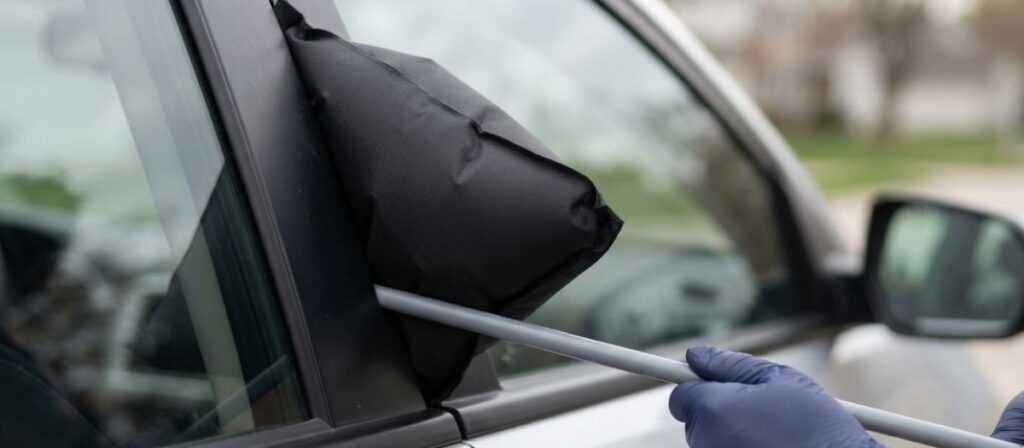
The long-reach tool, a thin flexible rod, slides through a small gap created between the window and the door frame to press the interior unlock button or pull the door handle directly. This is generally considered the safest non-destructive method available on vehicles where it applies, since it never touches the lock mechanism itself.
The air wedge creates that small gap in the first place. It’s an inflatable bladder inserted at the top corner of the door and gently pumped, opening just enough space to insert a long-reach tool without bending the frame or straining the weather seal.
The slim jim, a thin flat metal strip, works by sliding between the window glass and the weather stripping to manipulate the locking linkage from inside the door panel directly. It’s the method most associated with this kind of work, but it’s also the one most misunderstood. Used correctly on a vehicle where it’s actually appropriate, it’s fast and clean. Used blindly on the wrong vehicle, it can catch a wiring harness or a linkage rod and leave the lock working worse than before.
How a Locksmith Opens a Locked Car on Newer, Electronically Secured Vehicles
Newer vehicles change the calculus almost entirely, and this is where the biggest gap in most DIY advice, and even a lot of competitor content, actually sits.
Modern cars increasingly use deadlocking, a security state where the interior door handle won’t release the lock even when pressed, specifically to defeat exactly the long-reach and slim jim methods described above. On a deadlocked vehicle, forcing those techniques doesn’t just risk damage, it often doesn’t work at all.
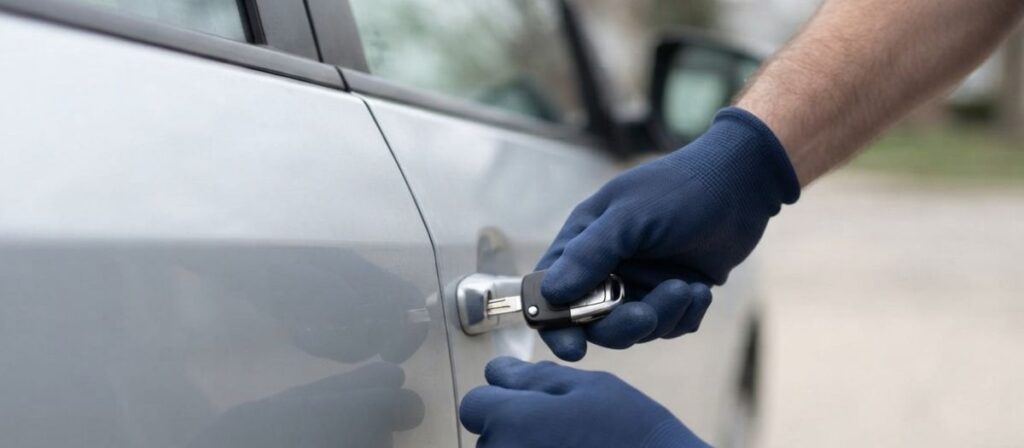
For these vehicles, a locksmith is more likely to use lock picking with a tension wrench, manually manipulating the external lock cylinder the way a key would, or a Lishi pick, a titanium tool cut to match a specific keyway that sets each internal wafer into position one at a time. Lishi picks are precise and fast in trained hands, but one pick doesn’t fit every keyway, so a technician needs to correctly identify the lock family before starting.
If the vehicle uses keyless entry or push-to-start, the fastest and safest route often isn’t a physical tool at all. A locksmith can sometimes resolve the lockout through the key fob or the vehicle’s telematics system directly, without touching the door mechanism. This matters increasingly around Urbana and Campustown, where newer leased vehicles and campus-area rental fleet cars are more common than they were even a few years ago, alongside the older, mechanically simpler cars many longtime residents and students still drive.
Why the Same Method Doesn't Work on Every Car
This is the section most competitor articles never really answer, even the ones with detailed tool lists. A ten-year-old sedan and a current-model SUV are not interchangeable jobs, even when both look like a straightforward “keys locked inside” situation from the outside.
Side airbag sensors are now frequently built into the door panel itself on newer vehicles, sitting close to exactly where a slim jim or long-reach tool would normally travel. A technician unfamiliar with a specific make and model risks triggering a fault code or, in rare cases, damaging the sensor entirely by using a technique that would be perfectly safe on an older car with no airbag wiring anywhere near the door.
Frameless windows, common on some coupes and higher-end trims, also change the approach, since there’s no fixed window frame to create a stable wedge point against. And vehicles with laser-cut or high-security keyways may need a decoder tool or key reader rather than a standard pick, since the internal tolerances are tighter than a general-purpose Lishi pick can reliably work with.
This is the actual answer to why one method gets chosen over another: not a fixed hierarchy of tools, but a match between the vehicle in front of the technician and the technique least likely to cause a problem on that specific car.
Common Mistakes That Turn a Lockout Into a Repair Bill
Most avoidable damage traces back to the same handful of decisions, usually made under stress rather than through carelessness.
Prying the top of the door open too far with a screwdriver or a household wedge is one of the most common, since even a small amount of excess force can bend the frame permanently. It may not be obvious at the moment, but wind noise, a water leak weeks later, or a door that no longer sits quite right are the delayed signs of this kind of damage.
Poking at the lock or handle directly with a metal tool scratches paint and can snap interior clips or trim that aren’t visible until the door panel is later removed for an unrelated repair. Using a coat hanger is a variation on the same problem, since a bent wire hook can just as easily snag a wiring harness as it can find the actual linkage rod.
Trying to force a stiff key, especially in cold weather, is its own common failure point in Central Illinois winters, and it’s a frequent cause of a key snapping off inside the lock or ignition barrel, turning a simple lockout into an extraction job.
Confirming It's Actually Your Car Before Anything Starts
This step gets a single passing mention across almost every competitor article researched, and it deserves more than that. A legitimate technician will ask for proof of ownership, typically an ID matching the vehicle’s registration, before beginning any entry work, not just show up and unlock whatever car you’re standing next to.
This isn’t bureaucracy for its own sake. Illinois locksmiths operate under licensing requirements set out in 225 ILCS 447, and that verification step protects you as much as it protects the business performing the work. If a technician skips this step entirely and starts working without asking, that’s a reasonable moment to pause and ask who you’re actually dealing with.
What Happens After the Door Opens
A detail almost no competitor content covers at all: opening the door isn’t the last step of a proper job. A trained technician tests the lock and, if a key is available, the key itself, to confirm both still function correctly after entry.
This matters because a lock that opened successfully but now feels stiffer, or a mechanism that engages unevenly compared to before, is a sign something shifted internally during the process, even if the door looks fine from the outside. Catching that immediately, while the technician is still on scene, is a very different outcome than discovering a lingering issue a week later with no one left to call about it.
Frequently Asked Questions
Can someone actually open a car door without a key and without damaging it?
Yes, when the right method is matched to the vehicle. Non-destructive entry tools are specifically designed to manipulate the lock or handle mechanism without forcing the frame, seal, or trim, unlike household tools improvised for the same purpose.
What tools can unlock a car lock without breaking it?
Long-reach tools, air wedges, lock picks with tension wrenches, and Lishi picks are the standard professional tools, chosen based on the vehicle’s lock type and age rather than used interchangeably.
Can a locksmith open a car door with something like a bobby pin?
Not reliably on a modern vehicle. Bobby pins lack the precision and torque control of a proper tension wrench and pick set, and attempting it on an electronically secured lock is far more likely to fail or cause damage than succeed.
How can I unlock my car if I locked my keys inside and I'm not near home?
A licensed automotive locksmith can typically reach you and perform non-destructive entry on-site anywhere in Urbana or Champaign County, without needing to tow the vehicle anywhere first.
Why can't I just use the same trick I saw in an online video?
Videos usually show one specific vehicle, often an older model with a simpler lock system. The same technique can be completely wrong for your car’s lock layout, deadlocking system, or door construction, which is exactly how DIY attempts cause expensive damage.
How much does a professional non-destructive car unlock cost in the Urbana area?
Pricing depends on the vehicle’s lock type and how the technician needs to access it, with electronically secured or high-security vehicles generally costing more than a straightforward mechanical entry. A locksmith can quote an exact price once they know your vehicle’s make, model, and situation.
Will a locksmith ask for ID before unlocking my car?
Yes, a legitimate technician should ask for proof of ownership or registration before beginning work. This is standard practice under Illinois locksmith licensing requirements, not an unusual request.
✅ Key Takeaways
How a locksmith opens a locked car comes down to matching the right technique to the vehicle in front of them, not applying one fixed method to every situation. Older, mechanically simple cars generally allow long-reach or slim jim entry, while newer, electronically secured vehicles usually call for lock picking, a Lishi pick, or a fob-based solution instead. A proper job also includes verifying ownership before starting and testing the lock afterward, two steps most DIY attempts and even some competitor guides skip entirely.
If you’re locked out and unsure which category your vehicle falls into, that uncertainty is itself a good reason to call rather than guess. Call (217) 288-2915 for automotive lockout assistance anywhere in Urbana or Champaign County, or visit our automotive locksmith services page to see what’s included.
- Available Right Now
Dealing With a Lockout Right Now?
Locksmith Urbana IL is available 24 hours a day, every day. Same-day service, upfront pricing, and a local technician who knows the Champaign County area.
Most calls in ZIP 61801 & 61802 see a technician on-site within 35 minutes