
- Safe Lockout Guide
What to Do If You Forget Your Safe Combination
- Locksmith Urbana IL
- 8 min read
- Urbana, IL. 61801 / 61802
Every locksmith who works on safes has heard some version of the same call: “I know it’s in here somewhere, but I cannot for the life of me remember the numbers.” A forgot safe combination situation feels urgent, especially if important documents or cash sit behind that dial, but the right response isn’t panic or a screwdriver. It’s a specific sequence, cheapest and least invasive options first, more involved methods only when those don’t work.
This guide walks through that actual sequence, what a locksmith needs from you at each step, and a few Champaign County-specific scenarios most national articles never address.
The Actual Order Locksmiths Follow
Nearly every article on this topic lists the same three or four options, manufacturer retrieval, override key, drilling, as an unordered menu. In practice, a locksmith works through these in a specific order, starting with whatever gets you back into the safe with the least cost and the least damage.
First, check for an override key or backup access method. Many combination safes, particularly residential and small business models, include a mechanical override keyhole specifically for situations like this. If your safe has one, locating the spare key that came with it solves the problem immediately without involving a locksmith at all.
Second, attempt manufacturer combination retrieval. If no override key exists or can’t be found, the next step is contacting the safe’s manufacturer directly using its serial number, generally located on the door, back panel, or interior of the safe. This is worth understanding clearly: manufacturers generally will not give the combination out over the phone directly to whoever calls, for obvious security reasons. A locksmith typically handles this retrieval on your behalf, and it only works if the combination was never changed from the factory default.
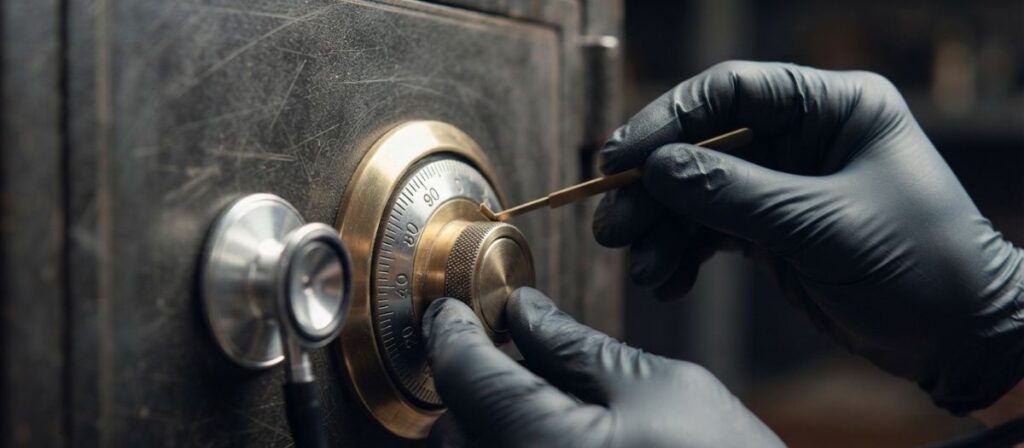
Third, non-destructive manipulation. For mechanical dial safes specifically, an experienced locksmith may be able to open the safe through manipulation, a technique involving careful, patient work with the dial to detect internal movement, without ever drilling or damaging the lock. This isn’t guesswork or brute force; it requires real skill and time, and it isn’t always possible depending on the specific lock mechanism.
Fourth, and only as a last resort, professional drilling. When none of the above works, drilling becomes the remaining option. This is intentionally the final step in the sequence, not the default response, because it’s the only method that damages the lock mechanism in the process of gaining access.
What Manufacturer Retrieval Actually Requires
This is the step most competitor content glosses over, treating it as a simple phone call rather than explaining what actually needs to happen.
Have your safe’s serial number ready before calling, since this is the primary identifier a manufacturer uses to look up the factory-set combination on file. It’s typically stamped on the back panel, the door edge, or occasionally inside a drawer or compartment within the safe itself. If you can’t locate it, a locksmith can often help identify where your specific brand places this number.
You’ll also need proof of ownership, which the manufacturer requires before releasing any combination information, again for security reasons. This might be a purchase receipt, an owner’s registration on file with the manufacturer, or, in some cases, proof tied to the property where the safe is installed.
This process only succeeds if the combination was never changed after the safe left the factory. If a previous owner reset the combination and didn’t record the new one anywhere, manufacturer retrieval won’t help, since there’s no factory record of a combination that was never registered. In that case, the next step in the escalation, manipulation or drilling, becomes necessary regardless of how quickly you can reach the manufacturer.
When You Didn't Set the Combination Yourself
This is a genuinely underexplored scenario that competitor content mentions only in passing, and it’s more relevant to Champaign County than most markets, given the area’s rental density near UIUC and its stock of older homes around Downtown Urbana.
If you’ve inherited a safe, from a family member, through an estate, or discovered one left behind in a home or office you recently purchased or leased, the ownership verification question becomes more complicated than a straightforward retrieval. A locksmith legitimately needs some form of documentation establishing you’re entitled to have that safe opened, since opening someone else’s locked safe without authorization is exactly the kind of request a licensed locksmith should decline.
Depending on the situation, this might mean a deed or closing documents for a property purchase, a lease agreement if the safe came with a rented commercial space, or probate documentation if the safe belonged to a deceased relative. If you’re in this situation, gathering whatever documentation establishes your legitimate claim to the property or estate before calling saves time, since a locksmith will need to see something before proceeding regardless of how understandable the situation is.

Drilling Isn't the Final Step, It's the Start of Repair
Nearly every competitor mentions drilling as the last-resort solution and stops there, as if getting the door open ends the process. It doesn’t.
Drilling a safe typically targets the lock mechanism directly, often the drive cam or a specific point identified through the lock’s technical documentation, in order to disable the locking bolts and open the door with minimal damage elsewhere on the safe. Once the safe is open, that damaged component generally needs to be repaired or replaced before the safe can be reliably relocked and used going forward. A safe that’s been drilled but never repaired often can’t secure anything afterward, since the very mechanism that held it locked is now compromised.
A locksmith who drills a safe should include this repair as part of the same service, not treat access as the finish line while leaving you with a safe that no longer functions as a safe. If you’re getting quotes for this work, confirm that post-drilling repair is included, or at least clearly priced separately, rather than assuming “opening” automatically means “restoring to working condition.”
Gun Safes Sometimes Need a Different Approach
Central Illinois households have a meaningfully higher rate of gun safe ownership than many other regions, and this specific safe type deserves its own brief mention since the opening approach can differ from a standard document or cash safe.
Gun safes frequently use reinforced locking bars running along multiple sides of the door rather than a single bolt, along with, on newer models, a biometric or electronic keypad layered with a mechanical backup. This layered design means a locksmith needs to correctly diagnose which specific mechanism is actually preventing entry, a dead battery in an electronic keypad is a very different problem than a jammed mechanical override, before choosing the right approach. If you own a gun safe and are dealing with a lockout, mentioning the specific brand and lock type when you call helps a locksmith arrive prepared with the right diagnostic approach rather than guessing on-site.
When Opening the Safe Costs More Than Replacing It
This is a practical, honest consideration no competitor content addresses directly, and it’s worth raising before you commit to a repair.
An older, low-value safe, particularly a decades-old model with a basic mechanical lock and no meaningful fire or burglary rating, sometimes costs more to professionally open and repair than it would cost to simply replace with a new unit offering better protection. This is especially true if drilling is required and the resulting repair involves sourcing parts for an older or discontinued model, which can add both cost and delay.
Before committing to an opening and repair, it’s worth asking your locksmith for an honest assessment of the safe’s actual value and condition, not just quoting the job. In practice, most locksmiths will tell you directly if a safe isn’t worth the cost of saving, and that honesty is worth more than getting a decades-old safe reopened only to replace it a year later anyway.
Frequently Asked Questions
How do I reset my safe combination if I've forgotten it?
You generally need to gain access to the safe’s interior first, either through manufacturer retrieval, manipulation, or drilling, before a new combination can be set. Resetting the combination isn’t possible until the safe is actually open.
Is there a master code that works on all safes?
No. Master or override codes, when they exist, are specific to a particular safe’s electronic lock model and are typically obtained through the manufacturer using your safe’s serial number, not a universal code that applies across brands.
How do I unlock a safe with a 3-number combination if I've forgotten the sequence?
A locksmith can attempt non-destructive manipulation on a mechanical dial safe, or pursue manufacturer retrieval using the serial number if the combination was never changed from the factory setting. Attempting to guess the sequence yourself risks damaging the lock further.
Can a magnet open a safe?
No. Modern combination and electronic safe locks aren’t affected by external magnets, and this is a persistent myth. Attempting it wastes time and doesn’t address the actual mechanism preventing entry.
Can a safe combination be changed after it's opened?
Yes. Once a locksmith gains access, whether through retrieval, manipulation, or drilling and repair, resetting the combination to something new is a standard part of the service, so you’re not left relying on the old or factory-default combination going forward.
What should I do if I'm locked out of a safe I inherited or found in a property I just purchased?
Gather any documentation establishing your legitimate claim to the property or estate, a deed, closing paperwork, or probate documents, before calling a locksmith, since proof of ownership is required before a locksmith can legitimately open a safe that isn’t registered in your name.
Is it cheaper to open and repair an old safe or replace it entirely in Champaign County?
It depends on the safe’s age, condition, and value. For older, low-security models, particularly if drilling and part replacement are required, a locksmith can give you an honest comparison between repair cost and the price of a new safe offering better protection.
✅ Key Takeaways
A forgot safe combination situation has a clear path forward: check for an override key first, attempt manufacturer retrieval using your serial number and proof of ownership, consider non-destructive manipulation for mechanical dial safes, and treat drilling as the last resort it’s meant to be, one that includes repairing the lock mechanism afterward, not just gaining one-time access. Inherited or found safes add an ownership verification step worth preparing for in advance.
If you’re locked out of a safe anywhere in Urbana or Champaign County, gather your serial number and any ownership documentation before you call. Reach Locksmith Urbana IL at (217) 288-2915, and we’ll walk through the right approach for your specific safe rather than jumping straight to drilling. Visit our Safe Opener Locksmith Services page to see the full range of safe and lock work we handle.
- Available Right Now
Dealing With a Lockout Right Now?
Locksmith Urbana IL is available 24 hours a day, every day. Same-day service, upfront pricing, and a local technician who knows the Champaign County area.
Most calls in ZIP 61801 & 61802 see a technician on-site within 35 minutes