
- Safe Lock Guide
Fire Rating vs Burglary Rating on Safes: What the Numbers Actually Mean
- Locksmith Urbana IL
- 8 min read
- Urbana, IL. 61801 / 61802
Most people buy a safe once, under time pressure, based on the size of the door and the price on the sticker. Then something happens, a break-in attempt or a house fire, and they discover what the labels actually meant. Fire rating vs burglary rating on safes isn’t one spec sheet with two numbers on it. They’re two completely separate tests, built by different engineering approaches, measuring two entirely different risks.
This guide explains what each rating actually tests, why a safe built for one often performs worse at the other, and a few decisions Champaign County homeowners and business owners should make deliberately rather than by accident.
Two Different Tests, Two Different Problems
A fire rating measures how long a safe’s interior stays below a survivable temperature during a real fire, tested under UL Standard 72. The safe is placed in a furnace reaching roughly 2,000°F, and the rating reflects how long the inside stays below a specific threshold before contents would be damaged.
A burglary rating measures something entirely different: how long a safe resists a person actively trying to force their way in, using specified tools, under UL Standard 687. A residential security container is built to slow down an opportunist for a few minutes; a UL TL-15 or TL-30 rated commercial safe is built with substantially thicker steel and hardplate to resist drilling, prying, and power tools for a documented, tested duration.
These aren’t stackable features on the same spec sheet. A safe can carry a fire rating with no burglary rating at all, or a burglary rating with no meaningful fire protection whatsoever. Reading a “fireproof” label and assuming it also means “burglar-resistant,” or the reverse, is the single most common and costly misunderstanding in safe shopping.
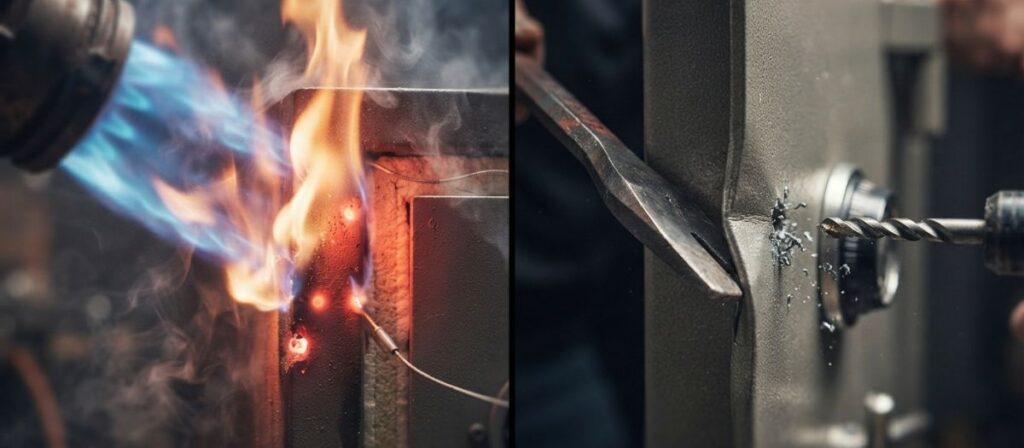
Why a Safe Can't Simply Be Optimized for Both
Here’s the genuine engineering trade-off almost every competitor skips, and it’s the actual answer to why these two ratings pull in different directions.
Fire protection is achieved with insulation. A fire-rated safe relies on a layer of fire-resistant material, often a lightweight composite or gypsum-based board, that absorbs and slows heat transfer to the interior. This insulation needs volume and low density to work effectively.
Burglary protection is achieved with steel. A burglary-rated safe relies on dense, thick steel plate and hardplate specifically to resist drilling, prying, and cutting tools. This construction is heavy and solid, essentially the physical opposite of the lightweight insulating layer a fire rating depends on.
A safe heavily optimized for fire resistance, thick insulation, thinner outer steel, is often genuinely easier to pry or drill than a dedicated burglary safe, because the insulating material simply isn’t dense enough to resist tools the way solid steel plate does. The reverse holds too: a safe built with maximum steel thickness for burglary resistance leaves less room, and often less budget, for the insulation layer a fire rating requires.
A genuine dual-rated safe, carrying both a real fire rating and a real burglary rating, has to compromise on both dimensions simultaneously, which is exactly why dual-rated safes cost meaningfully more and weigh considerably more than a single-purpose safe of the same size. This isn’t a sales upsell; it’s a real physical trade-off.
The Gun Safe Assumption That Costs People Real Protection
This is a genuinely important distinction almost no competitor states plainly, and it matters for a lot of Central Illinois households.
Most residential gun safes sold at big-box retailers are fire-resistant storage containers with a lock, not UL burglary-rated safes. A true UL burglary rating, even the entry-level TL-15, requires specific minimum steel thickness, weight, and lock standards that the vast majority of consumer gun safes were never built or tested to meet, regardless of marketing language like “security safe” printed on the box.
This doesn’t mean a typical gun safe offers zero protection against theft. Most carry a Residential Security Container (RSC) rating at best, built to resist a basic hand-tool attack by one person for a documented but much shorter duration than a true TL-rated safe. If you own a gun safe and have been assuming it carries meaningful burglary resistance beyond that RSC baseline, that’s worth reassessing, particularly if the safe is protecting anything beyond firearms that a real burglary attempt would realistically target.

Why the 350°F Number Isn't Arbitrary
Fire ratings get quoted as a bare number, “Class 350,” without explaining what that threshold actually protects against. Paper begins to char at roughly 400 to 410°F. UL’s fire rating standard specifically targets keeping a safe’s interior below 350°F throughout the test, a deliberate margin below the point paper actually starts to degrade, not a round number chosen for convenience.
This margin matters practically. A safe rated for one hour at Class 350 means the interior stayed below that 350°F threshold for a full hour during a test furnace reaching roughly 1,550 to 2,000°F on the outside. Given that most house fires are brought under control within that general window once a response arrives, a properly rated one-hour fire safe offers genuinely useful real-world protection for paper documents, not just a certification number for marketing purposes.
Digital Media Needs a Completely Different Rating
This is the detail that trips up more Champaign County businesses and UIUC-adjacent offices than any other point in this article, and most competitor content blurs it into the same sentence as paper protection.
Digital storage media, hard drives, USB drives, backup tapes, film, is damaged at much lower temperatures than paper chars at. A standard Class 350 fire rating, adequate for protecting paper documents, is not sufficient for digital backups. Media-specific fire ratings exist separately: Class 150 keeps the interior below 150°F, and Class 125 keeps it below 125°F, both meaningfully stricter thresholds built specifically for protecting data storage devices rather than paper.
If your business stores digital backups, server records, or irreplaceable digital files in a safe, confirm it carries a specific media-rated fire classification, not just a standard paper-rated Class 350 label. Putting a backup drive in a standard document fire safe and assuming it’s protected is one of the more common and expensive misunderstandings in this space, since the drive can be destroyed well before the safe’s rated paper-protection threshold is ever reached.
What Most Fire and Burglary Rating Guides Don't Tell You
A handful of practical realities get skipped or understated across the competitor content we reviewed.
You likely don’t need the highest rating available. TL-30X6 and TRTL-rated safes are built for bank vault and commercial cash-handling threat levels, resisting torches, power tools, and sustained professional attack across all six sides. For most Champaign County homeowners and small businesses, this level of protection is significant overkill against the realistic risk profile, an opportunistic residential burglary using basic hand tools, not an organized safe-cracking operation. Matching your rating to your actual risk, rather than defaulting to the highest number available, is the financially sensible approach most competitor content never states directly.
Bolting the safe down matters more than either rating. The most common way a home safe gets defeated isn’t through drilling or fire, it’s by being physically carried away to somewhere with more time and better tools. A safe under 500 pounds should be anchored to the floor or wall structure, and most safes ship with pre-drilled holes specifically for this. Neither a fire rating nor a burglary rating protects you if the entire safe simply walks out the door.
Confirm your insurance policy’s actual requirement, don’t assume. Insurance coverage for cash, jewelry, and valuables is often tied directly to a safe’s specific burglary rating tier, with higher-value coverage requiring a correspondingly higher UL rating. Before assuming your current safe adequately protects insured valuables, confirm with your insurance agent exactly what rating your specific policy requires, rather than discovering a coverage gap after a loss.
Unrated “fireproof” safes are common and worth checking carefully. Not every safe marketed as fireproof carries an independently verified UL 72 rating. Some manufacturers use internal testing or marketing language without third-party verification. If fire protection is the actual reason you’re buying a safe, look specifically for a stated UL classification and tested duration on the spec sheet, not just the word “fireproof” printed on the box.
Frequently Asked Questions
What is a good fire rating on a safe?
For most homeowners protecting paper documents, a one-hour Class 350 rating offers solid, genuinely useful protection given typical house fire response times. Businesses storing digital media need a separate Class 150 or Class 125 media rating, since standard paper ratings don’t protect data storage devices adequately.
What are the different burglary ratings for safes?
Common UL burglary ratings range from RSC (Residential Security Container, the basic entry-level rating) up through TL-15 and TL-30, tested for 15 and 30 minutes of net working time respectively, to TL-30X6 and TRTL-rated safes tested on all six sides against tools and torches for commercial and bank-level threats.
What is a B-rated safe?
A B-Rate is an older, catch-all industry construction classification for essentially any lockable steel box, with no independent testing behind the rating. It represents the lowest tier of burglary protection and shouldn’t be confused with a UL-tested rating like TL-15 or TL-30.
What does a 60-60-60 or 30-30-30 fire rating mean?
These notations typically refer to a safe surviving a specific temperature for a set duration across multiple test phases, heat exposure, impact, and cool-down, though exact terminology varies by manufacturer. Always check for a genuine UL 72 classification and tested duration rather than relying on manufacturer-specific shorthand alone.
Are fireproof safes fully fireproof?
No safe is completely immune to fire. A fire-rated safe is tested to keep its interior below a specific temperature for a documented duration under controlled conditions, not to withstand unlimited heat or fire duration indefinitely.
Will money burn in a fireproof safe?
Cash generally withstands heat reasonably well within a properly rated fire safe’s tested duration and temperature threshold, since paper currency chars at a similar temperature range to standard documents. A safe rated for the fire duration you’re realistically protecting against should keep cash intact.
Does my Champaign County business need both a fire rating and a burglary rating?
It depends on what you’re storing. Cash and valuables at real theft risk call for prioritizing a burglary rating, while important documents and backup records call for prioritizing fire protection. A genuine dual-rated safe covers both but costs and weighs meaningfully more than a single-purpose safe.
✅ Key Takeaways
Fire rating vs burglary rating on safes comes down to understanding that these are two separate tests solving two separate problems, insulation against heat versus steel against tools, and a safe built heavily for one often compromises the other. Most Champaign County homeowners and businesses don’t need the highest rating available in either category; they need the rating that actually matches what they’re storing and the realistic risk they’re protecting against.
If you’re choosing a safe for your home or business in Urbana or anywhere in Champaign County, or want to know whether your current safe’s ratings actually match what’s inside it, call Locksmith Urbana IL at (217) 288-2915. We can walk through what you’re protecting and recommend a safe rated appropriately, not just the most expensive option. Visit our Safe Locksmith Services page to see the full range of safe sales and service we handle.
- Available Right Now
Dealing With a Lockout Right Now?
Locksmith Urbana IL is available 24 hours a day, every day. Same-day service, upfront pricing, and a local technician who knows the Champaign County area.
Most calls in ZIP 61801 & 61802 see a technician on-site within 35 minutes